

How do you plan a wedding without pleasing everyone? Decide the big three with your partner first (guest count, budget, the feel of the day), then give family and friends specific jobs instead of votes. Aim to please your guests on the day, with good food, comfort and a clear plan, not every opinion during planning.
Is it actually possible to plan a wedding that makes everyone happy? No, and the sooner you stop trying, the better your wedding gets. Learning how to plan a wedding without pleasing everyone means choosing which kind of pleasing matters, and you can do that without turning cold or bossy. In banquet kitchens we never cooked 150 different dinners because 150 guests had preferences. We cooked one menu really well, served it hot and on time, and the room was happy. Couples on wedding forums keep landing on the same idea: hosting your guests well on the day is your job, keeping every relative’s vision alive during planning isn’t. And yes, a smaller guest list will upset someone, a skipped tradition will worry someone else, and you’ll survive both.
Below are 16 steps for the planning months, from deciding what the two of you want to handling the disappointment that’s left over, plus ready-to-use lines for the moments people push back.
Recommended Wedding Planning Essentials
A notebook and a budget planner sound basic, but having your decisions written down is what lets you stop re-arguing them.


Recommended blogs to read:
- How To Plan A Wedding When Families Disagree And Still Feel Like A Team
- How To Handle Wedding Opinions From Family Without Handing Over The Whole Wedding
- Wedding Family Boundary Mistakes That Quietly Take Over The Day
- How To Plan A Wedding After Getting Engaged When Everyone Has Opinions
- How To Plan A Wedding Around Your Values Without Losing The Plot
- How To Know What Kind Of Wedding You Want When Everything Looks Beautiful
Where Do You Start When Everyone Has an Opinion?
Start with the two of you, before anyone else gets a say. Agree on the size, the money and the feeling of the day, write it down, and decide which topics are open for input and which aren’t.
1. Decide what you and your partner actually want before asking for opinions
Opinions only feel overwhelming when there’s nothing to measure them against, so have the first conversation with your partner, alone, before the family group chat even knows there’s a date. Talk about what you picture: thirty people at a long dinner, a backyard ceremony, a courthouse and a restaurant, a church wedding with everyone you grew up with. Then talk about what you would hate.
You don’t need a mood board yet, just a few sentences you both agree on. Once you have them, every suggestion that comes in later is easy to sort: does it fit the picture or not? Without that, the loudest relative ends up drawing the picture for you.
2. Pick a few non-negotiables and write them down
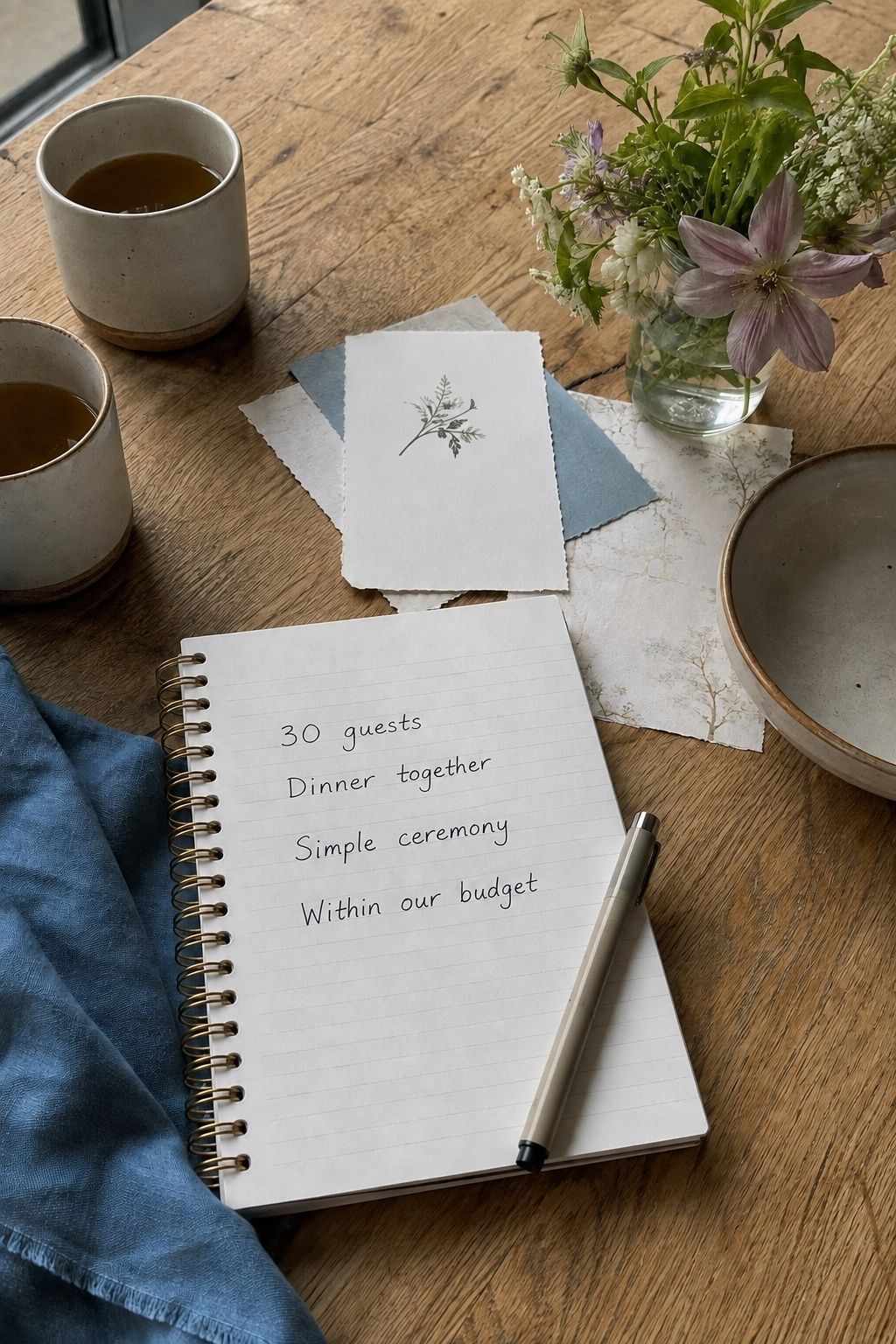
Write down three or four decisions that would change the whole feeling of the day if they moved, like the notebook here that just says 30 guests, dinner together, simple ceremony, within our budget. Everything else on the planning list can be flexible, and that’s the point, because when the list of firm rules is short, it’s believable. If you have forty non-negotiables, nobody, including you, takes any of them seriously. Common ones are the guest count, the total budget, whether kids are invited, alcohol, religious elements and whether there’s a wedding party. Keep the page somewhere you’ll see it, and read it before every family call.
3. Separate input from decision-making power
Asking someone’s opinion and giving them a vote are two different things, and most family fights start when people think they got the second one. Decide in advance which topics are open for input:
- Open for ideas: family photo combinations, a reading, music for the dinner, a recipe for the rehearsal
- Open for help: addresses, welcome bags, setup, a toast
- Decided by the two of you: guest count, budget, venue, ceremony style, vendors
Then say it out loud early, something like “We’d love your thoughts on the music, and we’ll make the final call once we know the budget.” It sounds formal, but it saves months of misunderstanding.
4. Clarify whether financial help comes with expectations
Money is where pleasing everyone gets complicated, because a check can quietly come with a guest list, a menu or a church attached. Before you accept a contribution, ask directly what the giver hopes for in return, in a friendly way, so it doesn’t feel like a contract negotiation.
Some parents give money as a gift and mean it. Others assume it buys seats for their friends or a bigger reception. Neither is wrong, but you need to know which one you’re dealing with before the money is spent, not after.
If strings come attached that you can’t live with, it’s completely okay to say thank you and plan a smaller wedding on your own budget. Gratitude and clarity fit in the same sentence: “We’re so thankful for the offer, and we need the final decisions to stay with us.”
How Do You Keep Family Included Without Handing Over Control?
Give people jobs, not votes. Most relatives want to feel part of the wedding, and a real role does that far better than a say in the guest list.
5. Let each partner handle their own family conversations
Hard conversations go better coming from the person with the longest history. Your mom can hear “we’re keeping it to 30 people” from you and be disappointed, but if your partner says it, she may hold it against them for years (fair or not, that’s how families work).
Agree on the wording together, then split the calls: you take your side, your partner takes theirs. Neither of you should play the villain alone, and neither should say “it was their idea” when it was a shared decision. If a parent calls the other partner to complain, that partner simply says “we decided this together” and passes the phone back.
6. Use kind scripts that do not reopen a closed decision
A good script is short and warm, it can be repeated word for word, and it doesn’t give new reasons each time, because every new reason sounds like something to negotiate. A few that work:
- “We know you hoped for that, and we’ve decided to keep the ceremony small.”
- “We understand why you asked. The guest list is full.”
- “Thank you for the idea. We’re going to keep it the way it is.”
Say the same line the second and third time. Repetition is boring, and boring is exactly what ends a debate. If you need to, write the line on a sticky note by the phone, nobody will know.
7. Offer roles that make people feel included without changing the wedding

Most people pushing for changes really want to feel part of it, so give them a real job with a beginning and an end. Your aunt can pack the welcome bags (the kraft bags, water and wrapped cookies here are exactly that kind of task), your dad can give a short blessing at dinner, your sister can collect addresses, your grandmother can lend her pearls. A contained role gives love somewhere to go without rearranging the whole event, and people tend to remember the job they did at a wedding long after they forget what they argued about.
8. Keep the guest list tied to space, budget, and relationship closeness
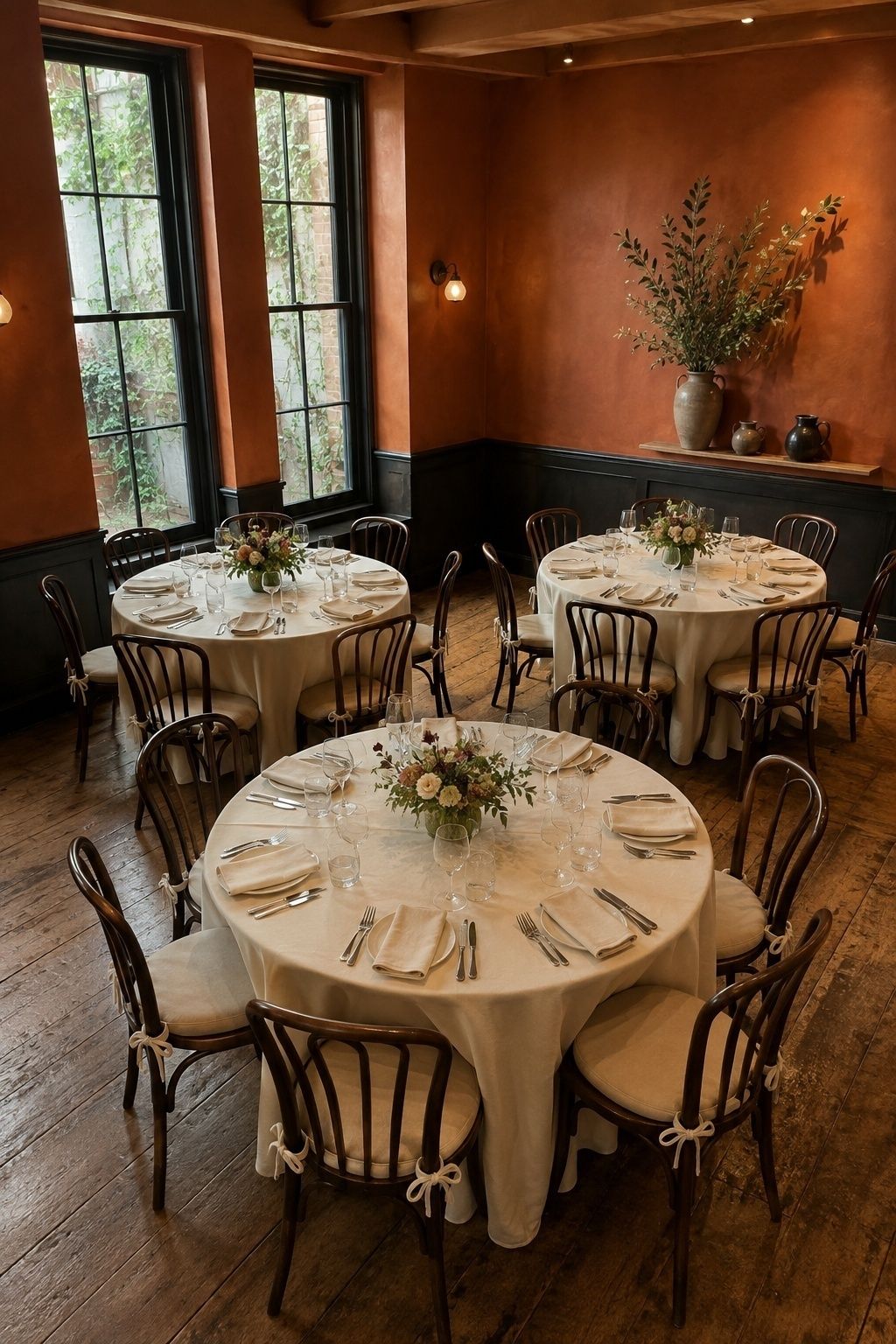
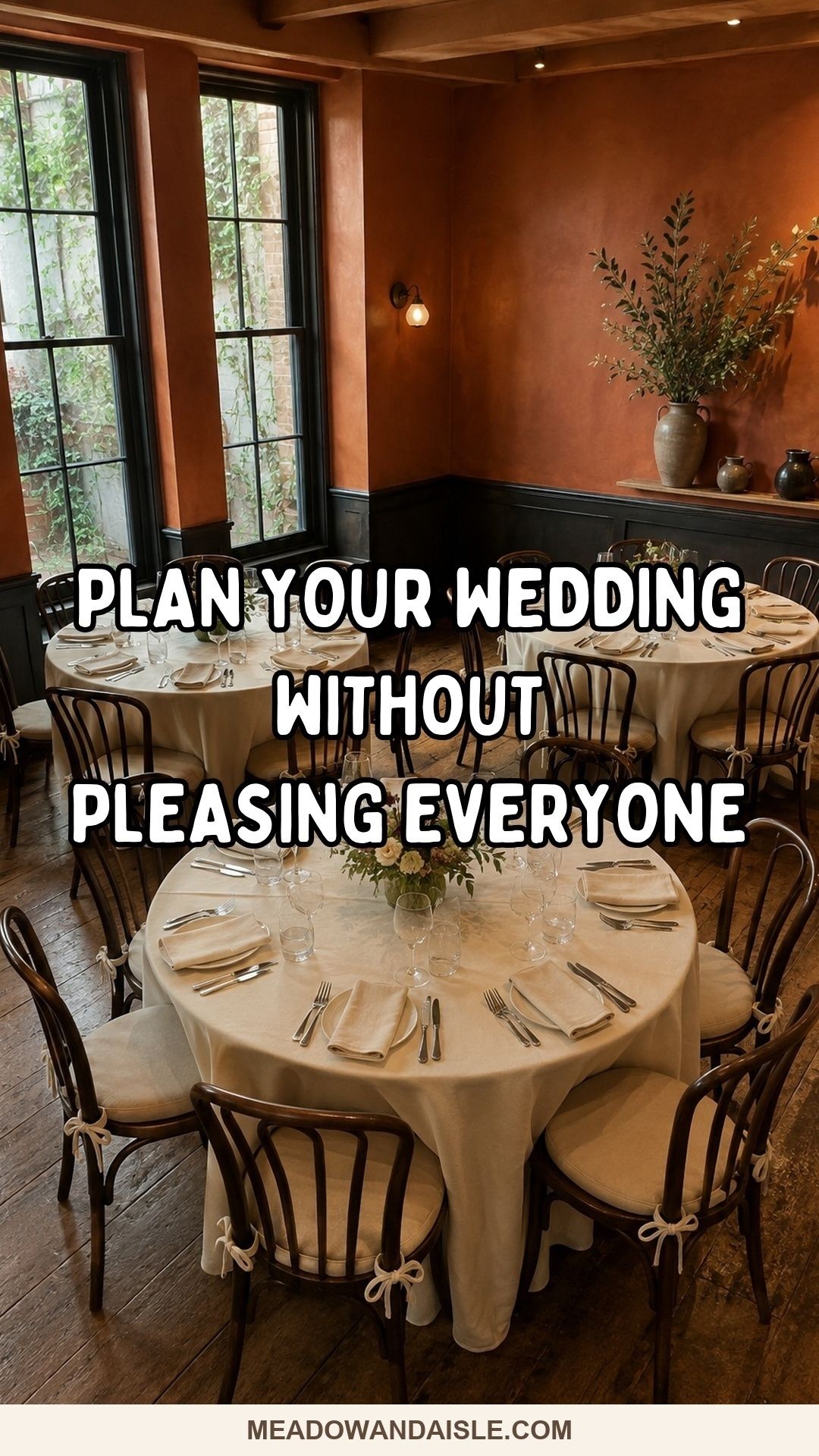
Guest list guilt grows when you judge every name alone, so judge them by rules tied to something real. A private room with three round tables like this one holds about 24 people, and that number doesn’t care how much your second cousin wants to come.
Use categories instead of individuals: immediate family, close friends you both see, partners you know by name. Then connect the list to the room, the meal cost per person and the feeling you chose.
When someone asks to add a name, you can point to the room and the rule instead of debating whether that person “deserves” a seat. It’s kinder for everyone, including the person who isn’t invited, because it was never about them.
9. Adapt meaningful traditions instead of automatically accepting or rejecting them
Before you say yes or no to a tradition, ask what it means to the person asking. Sometimes the answer surprises you: your mom doesn’t care about the bouquet toss, she cares that her side of the family gets a moment.
Once you know the feeling behind it, you have more options than yes or no. Keep it as is, shorten it, move it to the rehearsal dinner or honor it in a different way. A parent dance can become a family toast, a full religious ceremony can become a blessing at dinner. People usually accept a change much more easily when they can see you took the meaning seriously.
How Do You Handle the Disappointment That’s Left?
Accept that some disappointment will remain, stop explaining after the first clear answer, and protect the wedding day itself from new debates.
10. Stop explaining once you have given a clear answer
After you’ve answered kindly once, you don’t owe anyone a fresh reason every time they bring it up again, and adding reasons actually makes things worse, because each one is a new door to argue through. “I know this is disappointing, and we’re keeping the plan as it is” is a full answer, even the fourth time. It feels rude the first few times you do it. It isn’t. Calm repetition protects your energy and shows people where the edge is, and most will stop asking once they realize the answer won’t change.
11. Expect some disappointment without treating it as failure
Even a kind, well-planned wedding disappoints somebody. Someone wanted a bigger guest list, someone wanted a church, someone wanted to be a bridesmaid. That’s normal.
Their feeling is real and you can be gentle about it. It just isn’t proof that your plan is unkind. People are allowed to be disappointed and then come to the wedding and have a great time, and most of them do exactly that.
What helps is separating “they’re upset” from “I did something wrong”. If you were clear, fair and early, you did your part. Give them time, don’t rush to fix the feeling by changing the plan, and let them come around in their own time.
12. Protect the wedding day from last-minute emotional labor
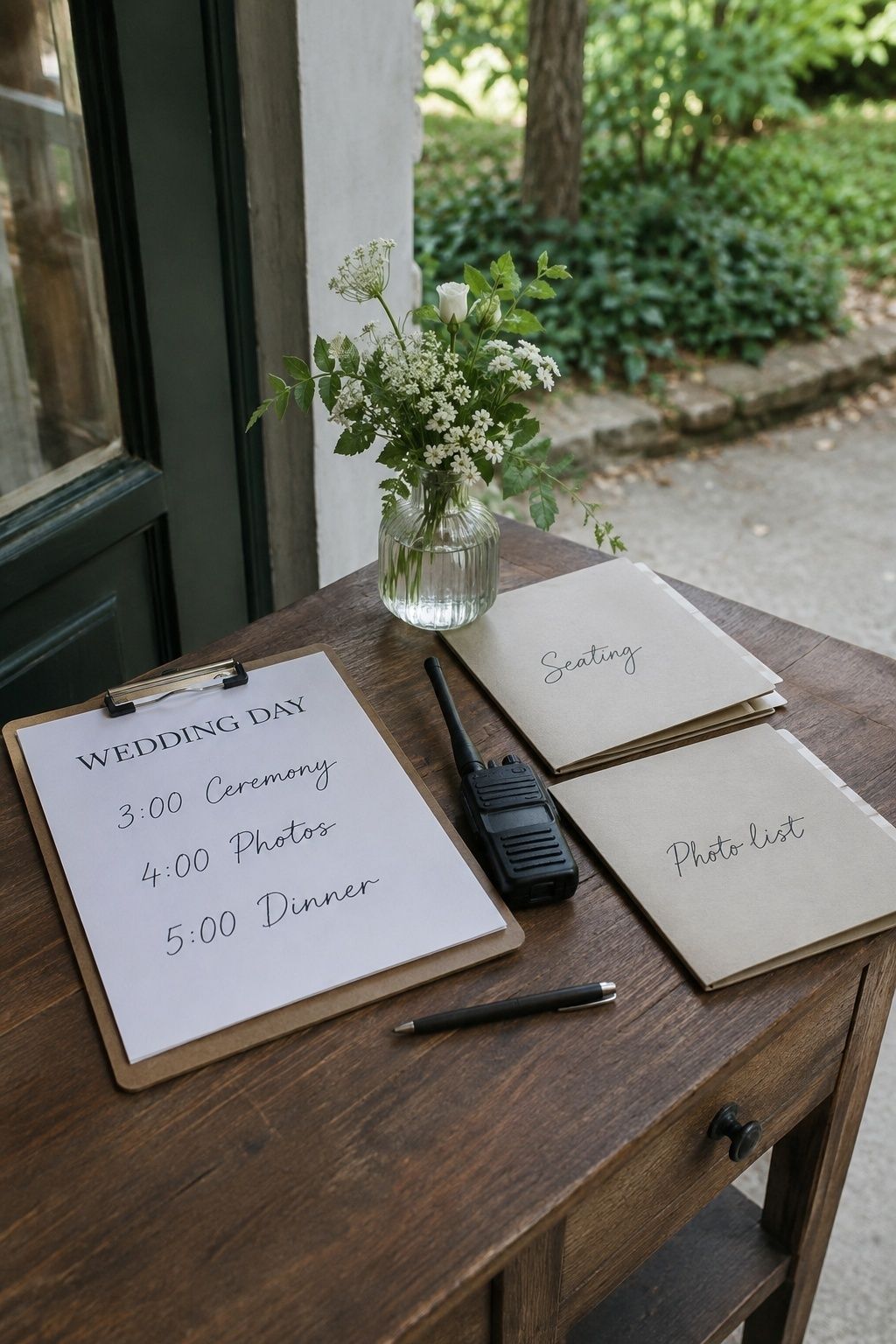
Family pressure has a way of showing up on the wedding morning, so hand the day over to someone else before it starts. Put the essentials on one clipboard like this, with the timeline (3:00 ceremony, 4:00 photos, 5:00 dinner), the seating folder, the photo list and a radio or phone for the coordinator, and give it to a planner or a steady friend.
- All day-of questions go to that person, not to you.
- Seating changes after the final count go through the coordinator only.
- If a relative starts a debate, the coordinator redirects it, kindly and quickly.
You shouldn’t be handling anyone’s feelings in your wedding clothes. If you’re still early in the process, there’s a full guide on planning a small wedding.
How To Keep A Small Wedding From Becoming A Family Debate
Small weddings make every choice more visible, so relatives sometimes read the size as a verdict on how much you love them. The calmer frame is that you chose a scale, not a ranking.
13. Explain the scale once, then move to logistics
Say the size clearly, one time: “We’re having a dinner for immediate family and our closest friends.” Then go straight to details, like the date, travel, the dress code or a later party for everyone else.
The move to logistics matters more than it sounds, because staying in debate mode makes the size feel undecided, even when it’s settled. Talking about which hotel to book signals that the decision is done and now you’re just planning. If someone circles back to the size, answer the same way once more and move to the next practical question, whether it’s parking, dress code or who’s bringing grandma.
14. Use the same guest-list rule for both sides whenever possible
Fairness is much easier to defend when both families follow the same rule. If each set of parents gets to suggest four names, it’s four on both sides, if plus-ones are only for partners you’ve met, that applies to your cousin and your partner’s college roommate alike, and if aunts and uncles are in but cousins are out, that line holds across the whole tree. Perfect symmetry isn’t always possible (one side may simply be bigger), but a shared rule turns personal arguments into a simple “that’s the rule we set for everyone”, which is a lot easier to say at a family dinner.
15. Build a few tender moments for people who are not invited

A small wedding doesn’t have to mean silence toward everyone else. A stack of “We are married” announcement cards like these, mailed the week after with a photo, tells people you thought of them.
There are other warm options too. Visit your grandparents the week before, call the godparents, host a relaxed backyard party a month later or send a short video from the ceremony.
Keep these gestures honest. They’re additions, not apologies for choosing a small wedding, so don’t write a long explanation of why someone wasn’t invited. A warm note and a photo say much more.
16. Remember that intimacy is a wedding choice, not a punishment
People who aren’t invited might feel hurt, and that hurt can make you feel like you did something to them. You didn’t. You chose an atmosphere: quieter, closer, cheaper, easier to be present for.
When the guilt shows up, remind yourself why you chose small in the first place. Write those reasons next to your non-negotiables if you need to. A wedding designed for the people in the room isn’t designed against the people outside it. Most of those people will be at your housewarming, your birthdays and the next twenty years of family dinners, and that’s where the relationship really lives.
What To Say When People Push Back
Prepared lines keep you from inventing diplomacy when you’re tired. Each one shows warmth, states the decision and closes the door gently.
When someone wants extra guests
“We understand why you’d love to include them. We’re keeping the list to the number our space and budget allow, so we’re not adding anyone.” Then change the subject to something they can help with.
When parents want a tradition you do not want
“We know that tradition means a lot to you. We’ve chosen a ceremony that feels right for us, and we’d love to honor the family in a different way, maybe with a toast at dinner?”
When money is being used as leverage
“We’re grateful for the offer, but we don’t want money to put pressure on our decisions. If it needs to come with conditions, we’ll plan without it.” Said calmly, this usually ends the leverage quickly.
When friends compare your wedding to someone else’s
“Their wedding sounded beautiful. We’re doing something smaller and quieter because it fits us.” For telling everyone else, read how to tell people you’re having a small wedding.
When you feel guilty after saying no
Say this one to yourself: “This feels uncomfortable, and the decision is still right for our wedding.” Then give the other person time, without rushing to change the plan. More etiquette posts are under Wedding Guests & Etiquette.
Is It Selfish to Plan the Wedding You Want?
No, it isn’t selfish to plan the wedding you want, as long as you host your guests well. Selfish would be inviting people and then leaving them hungry, cold or confused. Choosing the size, the style and the budget is simply your call as the couple, and taking good care of the people who come is how you show them respect.
Frequently Asked Questions
How do you plan a wedding without pleasing everyone?
Agree on your guest count, budget and the feel of the day as a couple first, decide which topics are open for input, and use short, repeatable lines when people push back. Focus your energy on hosting guests well rather than on keeping everyone’s opinions happy. See also how to plan a wedding when families disagree.
How do you stop being a people pleaser when planning a wedding?
Write your three or four non-negotiables down and read them before every family conversation. It’s much easier to hold a line you wrote in advance than one you’re inventing on the phone.
How do you set boundaries with family during wedding planning?
Name the specific rule instead of a general feeling, like “no extra guests” or “vendor decisions stay with us”. Say it once, kindly, and repeat the same words if it comes up again.
What do you do when parents want a bigger wedding than you do?
Explain the size once and tie it to real limits like the venue, the budget and the kind of day you want. If they’re paying, settle before accepting the money whether it comes with extra guests. You can also offer a bigger, casual party later for everyone else.
How do you deal with wedding guilt when people are disappointed?
Remember that their disappointment isn’t proof you did something wrong. If you told people clearly and early, you did your part.
Key Takeaways
- Agree on guest count, budget and the feel of the day before asking anyone else.
- Give relatives jobs, like welcome bags or a toast, instead of votes.
- Ask what strings come with financial help before the money is spent.
- Use one short script and repeat it, instead of adding new reasons.
- Hand the wedding day to a coordinator so you’re not managing feelings in your dress.
- Put your energy into hosting guests well, since that’s the pleasing that counts.
So, Can You Make Everyone Happy?
Back to the question at the start: no, you can’t, and a wedding that tries ends up feeling like it belongs to nobody. What you can do is make the people in the room happy on the day, with a warm welcome, a good meal served on time, comfortable seats and a plan that runs without you, and that’s the part almost everyone remembers. The relatives who wanted a different wedding will still eat the cake.
Last update on 2026-11-29 / Affiliate links / Images from Amazon Product Advertising API