

Most wedding transportation mistakes happen in the minutes around the vehicle, not on the road: no passenger list by leg, drive time without boarding and walking time, a vague pickup door, no plan for the last ride home, and the couple’s phone as the only contact. Fix those five and a single shuttle can run a small wedding calmly.
It’s 10:40 pm, the last shuttle left twenty minutes ago because the schedule said 10:20, and three of your guests are standing at the curb in heels while the rideshare app promises a car in 38 minutes. Nobody planned for that moment, and that’s usually how wedding transportation mistakes look in real life: small, late and right at the edge of the party. This is one part of wedding mistakes to avoid, which covers the rest of the day.
What follows is a plain checklist of the 13 transportation slips that strand guests or make them late, with the fix for each, sized for a small wedding where one van or a few cars might be all you need. You’ll also find what to put on the wedding website and who should hold the phone so it isn’t you.
Recommended Wedding Transportation Essentials
These are the small tools that make a pickup plan readable for guests and drivers.


Recommended blogs to read:
- Wedding Hotel Block Mistakes That Leave Guests Paying More
- New Years Eve Wedding Guest Transportation for a Safe Midnight Exit
- Day Of Coordinator Mistakes That Leave the Couple Running the Wedding
- Wedding Food And Bar Mistakes That Guests Feel Immediately
- Wedding Planning Mistakes That Quietly Make Everything Harder
- Wedding Day Stress Mistakes That Keep You From Feeling Present
Why Do Wedding Transportation Plans Go Wrong?
They go wrong because couples book a vehicle before they plan the movement. The van is rarely the problem; the missing headcount, timing and instructions around it are.
1. Assuming a Small Wedding Doesn’t Need a Transportation Plan
With 25 guests it’s tempting to say “everyone will just drive” and leave it there. That works only when every guest knows the area, has easy parking, has a safe way home after drinking and has a short, flat walk from the car to the ceremony.
The moment you add a hotel, an open bar, older relatives, a gravel lane, two locations or a venue outside town, the plan needs more than a group text. That doesn’t mean a fleet of buses. A 24-person dinner might need one accessible car for grandparents and a clear parking note, while a 50-person weekend at a countryside venue might need two runs out and a staggered ride back.
Write down every move guests make on the day, from hotel to ceremony to dinner to bed, and look at which ones they can’t do safely on their own. Those are the only legs you need to plan, and on a small wedding there are often just two or three.
2. Booking a Vehicle Before Mapping Every Passenger Group

The first question shouldn’t be how many seats fit the budget, but who needs to move, and when. The couple, parents, the wedding party, grandparents, readers, the photographer’s family list and the guests at the hotel block all leave at different times and from different places.
A passenger map comes before you call a single company. Give each group a color, write the headcount for every leg and sketch the route between stops, then line up the vehicle sizes against it (a car for four, a van for twelve, a minibus for twenty-five). Suddenly it’s obvious whether you need one big shuttle doing two loops or two small vehicles leaving at the same time. Mark anyone with mobility needs, a long dress or a job that depends on arriving early, because those people decide the first departure time for everyone.
3. Planning Around Drive Time Instead of Loading, Waiting and Walking Time

A twelve-minute drive is never a twelve-minute transfer. Guests have to find the lobby, wait for the stragglers, climb in with jackets and bags, unload, cross a parking lot, find the right door and sit down, and every one of those steps takes longer in dress shoes.
I learned the same lesson running banquet service: the plate isn’t the hard part, the moment of getting forty plates out of the kitchen at once is. A shuttle works the same way. Boarding 20 people takes five to ten minutes on its own, longer if anyone is carrying a garment bag or a gift.
A simple formula for each leg: drive time plus 10 minutes for boarding, 5 for unloading, 5 to 10 for walking and finding seats, plus a 15-minute buffer. For a ceremony at 4 pm and a 12-minute drive, that puts the last hotel departure at about 3:10, not 3:45.
What Goes Wrong at Pickup and on the Way Back?
Most problems at pickup come down to vague instructions, and most problems on the way back come down to too few return trips. Guests can handle almost anything if the information is exact.
4. Forgetting Shuttle Loops and Return Trips
The first run usually goes fine. It’s the second group, waiting at the hotel for a vehicle that’s still unloading at the venue, and the last group, waiting at the curb after dessert, who end up stranded.
Write the loop as a sequence rather than a promise:
- first pickup time and last ceremony-bound pickup
- how long one full round trip really takes
- seats per run, minus a couple for bags
- an early return around 9 pm for parents and anyone tired
- the final return window and who stays behind if it fills
Guests don’t need the routing sheet, but they do need two return times they can trust. I’d plan the ride home before anything else, because that’s the leg where people have been drinking, it’s dark and nobody wants to beg a cousin for a lift.
5. Giving Guests a Time but Not an Exact Pickup Spot
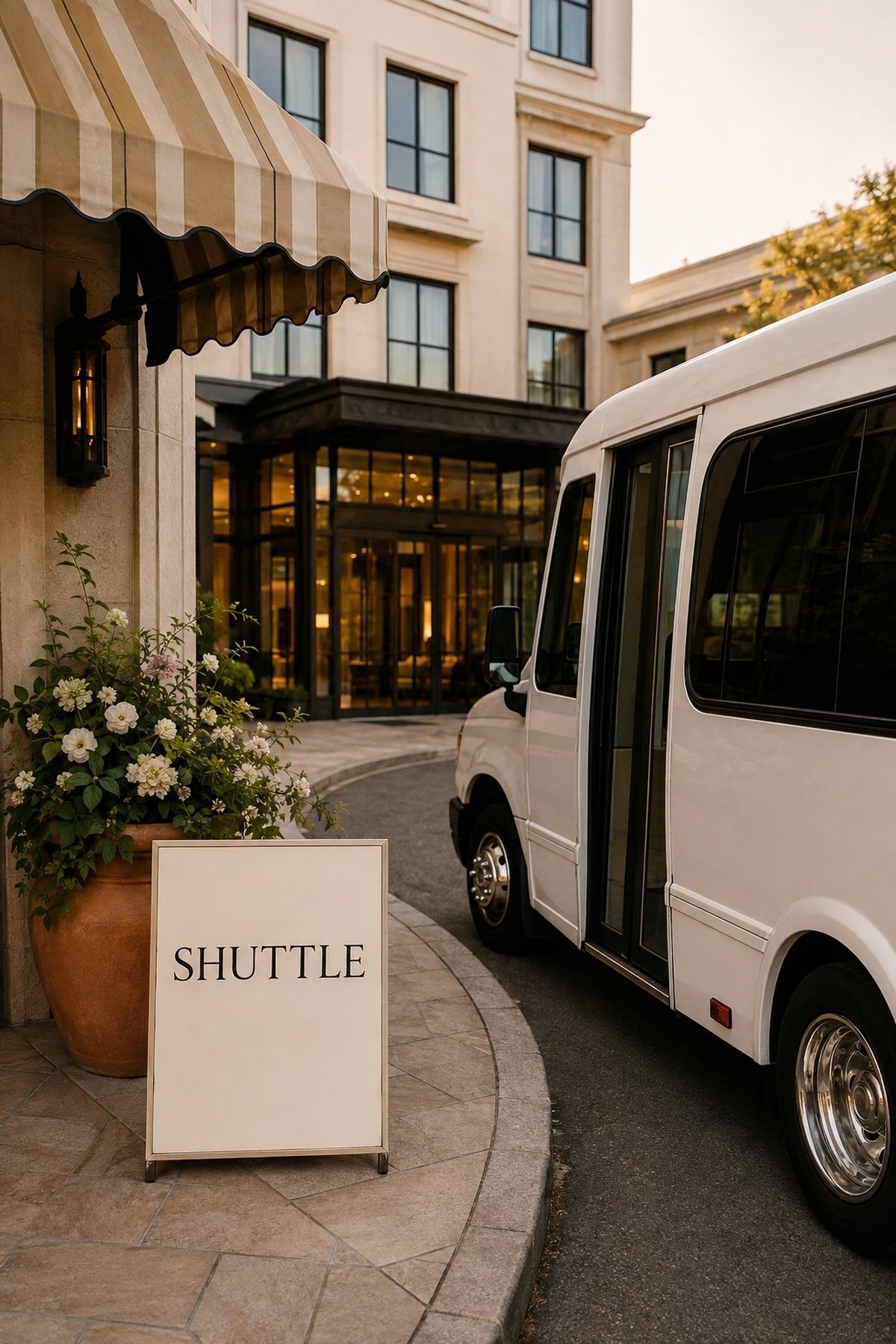
“Meet in the lobby at 3” sounds clear until the hotel turns out to have a main entrance, a conference wing, a valet circle and a side door the driver prefers. Half your guests wait inside, the other half wait outside, and the driver waits somewhere else entirely.
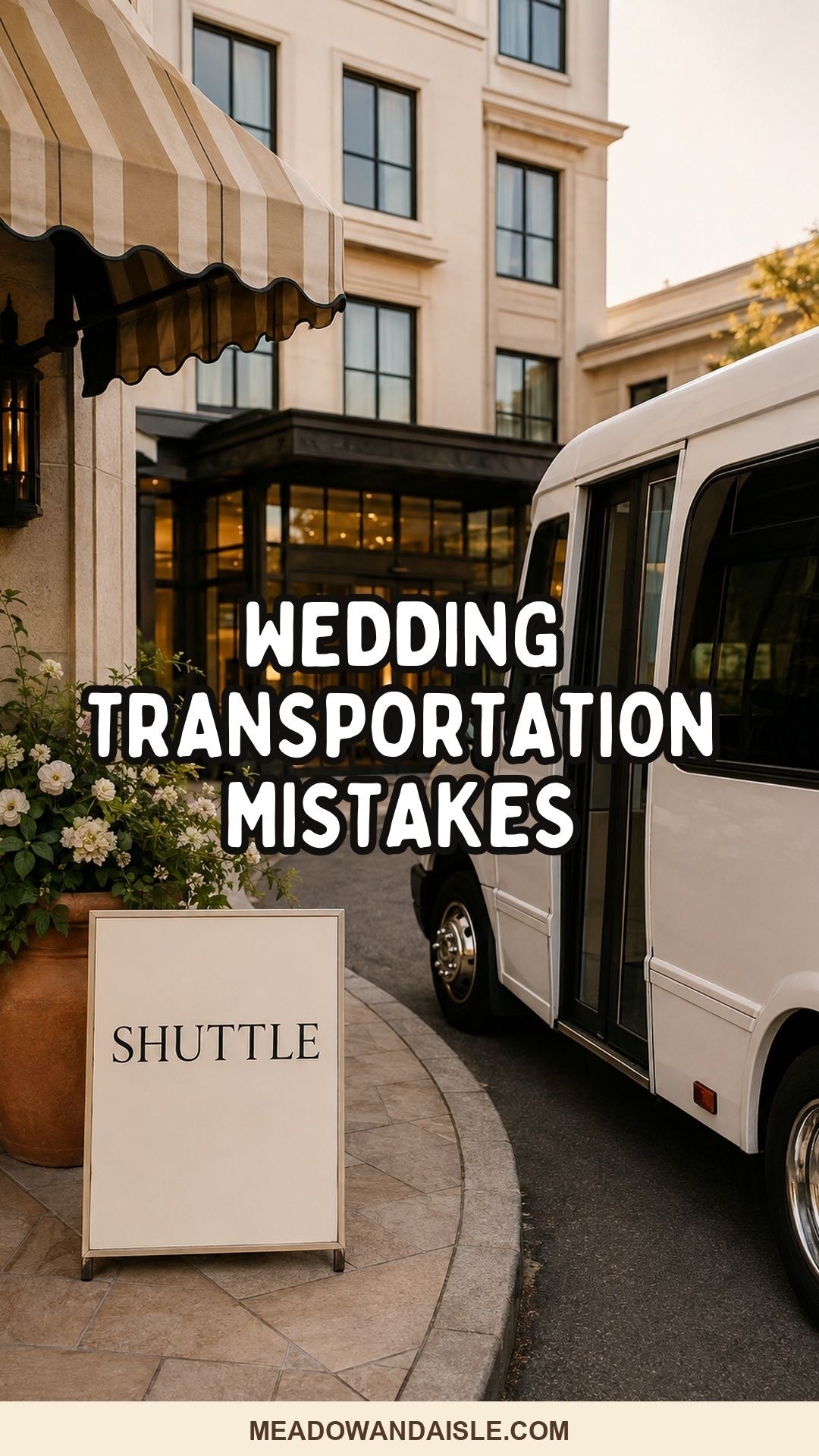
Name the exact door and something guests can see, like the side entrance under the striped awning, and add a sandwich-board sign that says SHUTTLE. Then give the time to be standing there, because “ready to board at 3:00, leaves 3:10” gets people downstairs, while “shuttle at 3:10” gets them leaving their rooms at 3:10.
6. Ignoring Traffic, Venue Access, Road Rules and Local Events
A vehicle can be perfectly on time and still not get guests to the door. Private driveways, gates with codes, one-way streets, weight limits on bridges, bus bans in old town centers, a stadium game, a marathon or a graduation weekend can all turn a simple route into a crawl.
Three questions for the venue settle most of it: where can a shuttle stop and turn around, does the drop-off reach the ceremony area or only the parking lot, and is anything else happening nearby that day. Then check the route on a map at the exact hour you’ll be driving it, on the same day of the week if you can.
Send the driver the approved route, gate code and drop-off point in writing during the final week. Nobody should be working out access from a curb with a van full of guests in their best clothes.
Who Gets Forgotten in the Transportation Plan?
The people who most need help moving are usually the easiest to overlook: older guests, anyone with mobility needs and the family members who have to be in three places for photos.
7. Forgetting Older Guests, Accessibility Needs and Weather Exposure
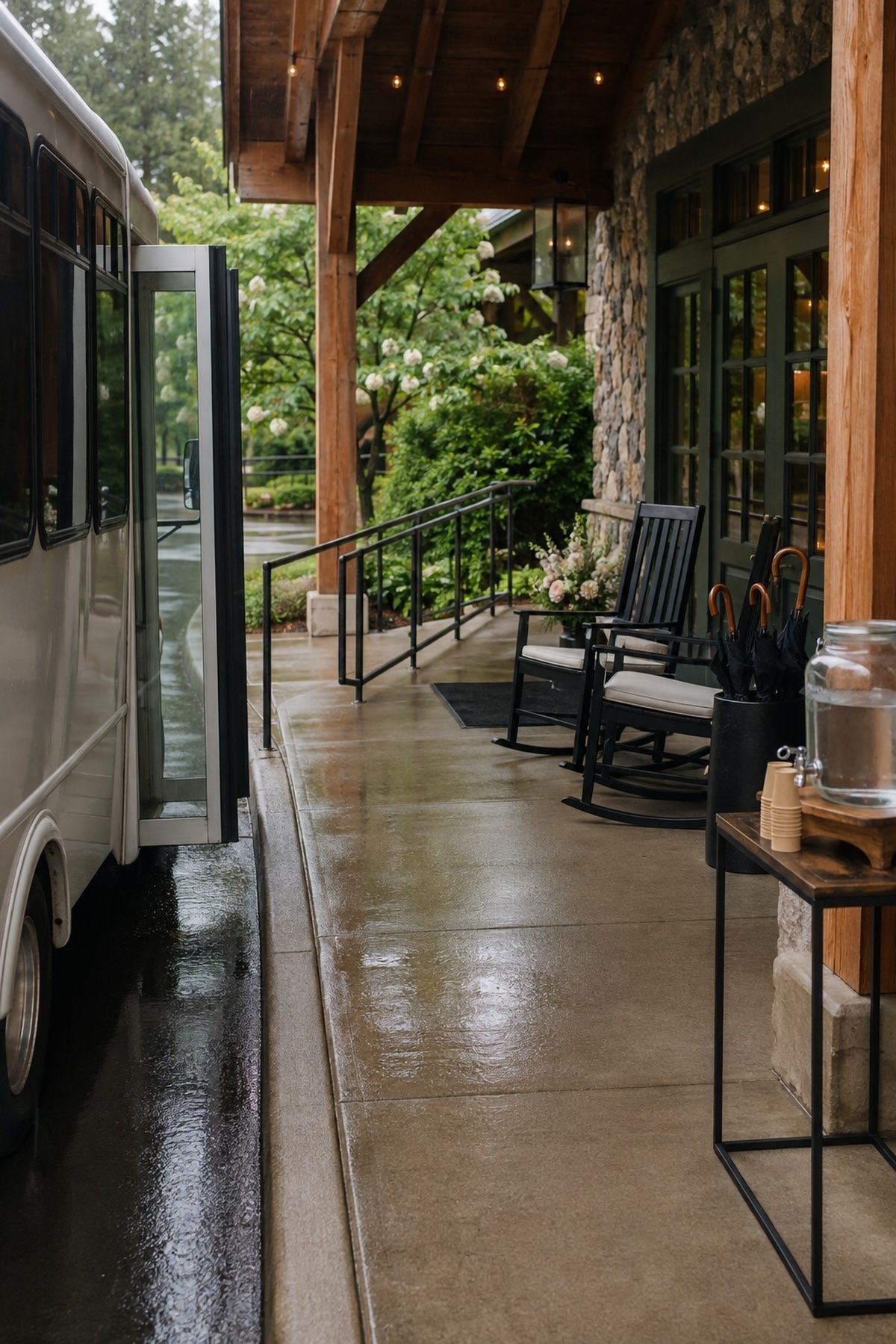
A shuttle line in the sun or a long gravel walk is a minor annoyance for a 30-year-old and a real problem for an 82-year-old grandmother, a pregnant guest, someone using a cane or anyone in heels. A general “shuttle provided” message doesn’t cover them.
Confirm how far the drop-off is from the seats and whether the path is paved, then look at where people wait. A covered porch with a railing, a few chairs and umbrellas by the door turns a rainy pickup into a non-event, and water nearby matters on hot days. For anyone who can’t manage the shuttle comfortably, book a separate car that drops them right at the ceremony entrance, and assign one person to walk them in. It’s a small cost, and it’s the kind of care families remember for years.
8. Leaving the Wedding Party, Family or Photo Transportation Uncoordinated
The people closest to you move the most. Parents and the wedding party might go from the hair and makeup suite to a first-look spot, then to the ceremony, then to a photo location, then to dinner, and each hop is a chance for someone to end up standing in the wrong parking lot holding a garment bag.
This group needs its own one-page brief, separate from the guest shuttle. List who rides from getting ready, who goes to photos, where family waits after portraits, who carries the dress bags and spare shoes, and how everyone reaches the reception. Put the names next to each car, because “the family car” means something different to everyone in the family.
With a small wedding party this can be two cars and a friend with a minivan, and that’s fine, as long as each driver knows exactly who they’re collecting and from where.
How Do You Hire Transportation Without Becoming the Contact?
Book on reliability, not only price, and hand every driver question to someone else. On the day, your phone should be in a bag somewhere.
9. Choosing the Cheapest Option Without Checking Reliability and Backup Support
A low quote looks great on the budget sheet, but transportation is one of the few vendors that can’t be fixed mid-day. If a van breaks down or a driver gets the time wrong, there’s no spare waiting around the corner unless the company has one.
Before you sign, get these answers in writing:
- which vehicle is guaranteed, and what happens if it’s off the road
- when the driver is assigned, and whether you get their number
- how overtime is billed, by the minute or by the hour
- who answers the phone after hours on a Saturday night
- whether a backup vehicle exists
Compare quotes on those answers, not only the seat price. Paying a bit more for a company that answers its phone at 11 pm is a better deal than a cheap one that doesn’t.
10. Making the Couple the Transportation Contact
On the wedding day, your phone should be with someone else. When the first shuttle reaches the wrong entrance or a guest misses the pickup, the driver needs to call a person who can answer, and you’ll be getting your makeup finished or standing at the front of the aisle. Pick one day-of contact for drivers and, if the group is big, a second person guests can text. A coordinator, a calm friend, the venue manager or the family member who loves a spreadsheet are all good choices. Give them the schedule, every driver’s number, the passenger counts, the route notes and permission to make small calls on the spot, like holding a shuttle five minutes for a late cousin. Put their name, not yours, on the wedding website and the guest cards.
11. Forgetting Rideshare Limits, Remote Venues and Cell Service
“Guests can just get an Uber” works in a city and fails quietly in the countryside. Remote venues often have weak cell signal, few drivers, long waits and surge pricing late at night, and a guest standing in a dark lane waiting for a car that never comes is the exact moment nobody wants.
The quickest check is to open the app at the venue address yourself at the same hour your reception ends, ideally on a weekend, and see what it shows. Ask the venue what usually happens at the end of their events, because they’ve seen it many times.
If coverage is weak, say so plainly on the website, so guests can plan a rental car, a designated driver or a hotel shuttle seat. People make good choices when they know the real situation in advance.
What Should Happen the Week of the Wedding?
One final transportation document, shared with every person who touches it, and a guest-facing version of the same plan in plain language.
12. Skipping a Final Transportation Handoff the Week of the Wedding
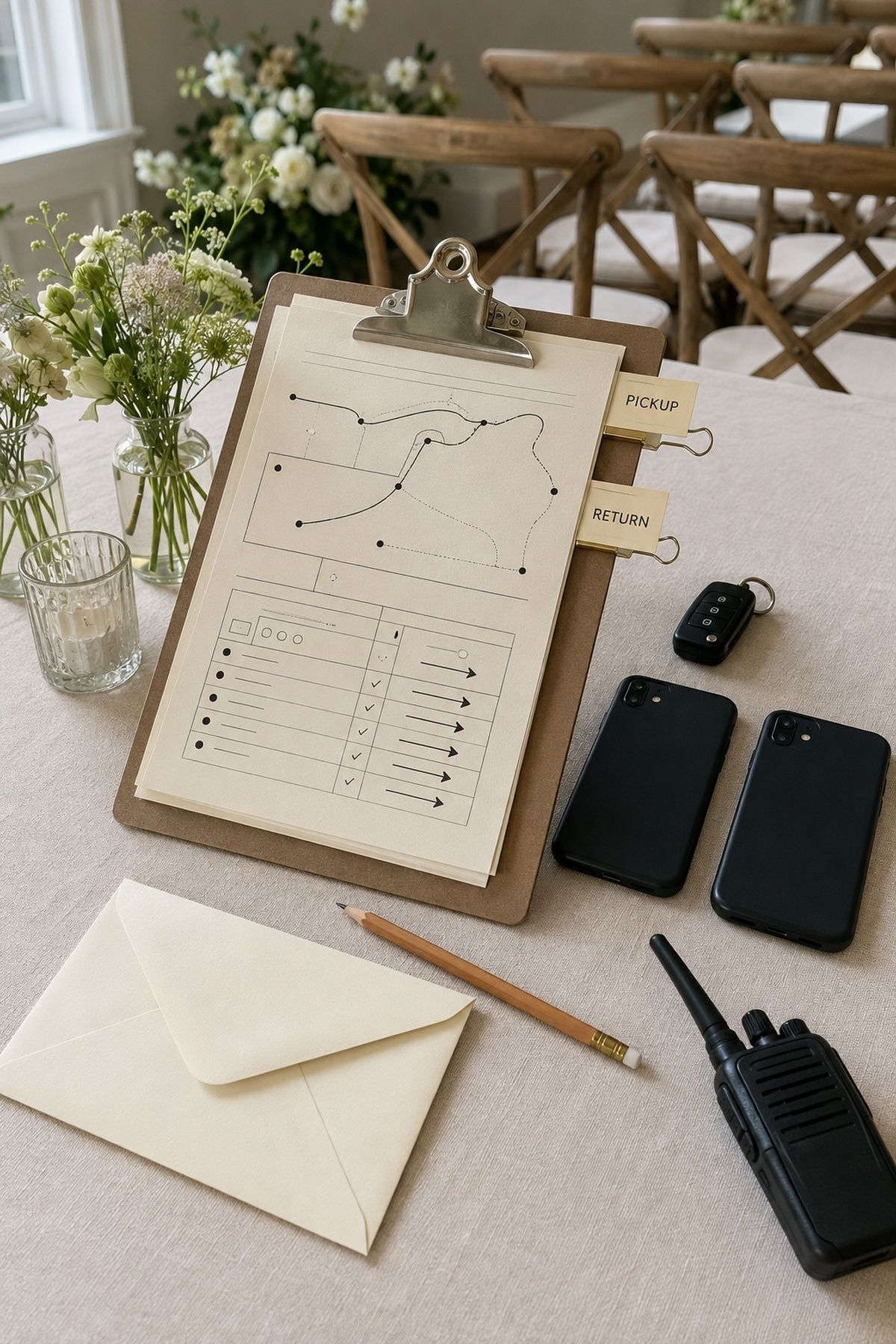
The last week is when the plan stops being theory. Headcounts shift, hotel pickup numbers firm up, portrait timing moves by twenty minutes and the weather forecast finally means something. If the details live in six email threads and a few texts, the handoff depends on someone’s memory at the busiest moment of the day. Browse Wedding Mistakes to Avoid for the other planning slips in this group.
Everything goes on one printed sheet on a clipboard: passenger groups, pickup doors, departure windows, the route, return trips, accessibility notes, every driver’s name and number, the backup contact and who owns each move. Send the same version to the coordinator, venue, hotel, family helper and transport company, and keep a couple of printed copies with the point person. For the person holding that clipboard, see day of coordinator mistakes.
13. Treating the Transportation Plan Like a Private Vendor Detail
If the shuttle schedule only exists in your inbox, guests will guess, and guesses look like people driving when they shouldn’t, missing the first departure or assuming there’s a late ride after the last one has left. If you’re sorting rooms too, wedding hotel block mistakes covers the other half of that puzzle.
The guest version can be short, and it belongs wherever people will look on the day: the wedding website travel page, a card in the hotel welcome bag and a text the morning of. Keep it to the pickup door, the ready-to-board time, the departure time, both return windows and one contact name. Write it so someone can read it on a phone in thirty seconds, standing in a hotel lobby. Planning for under 50 guests? Start with small wedding planning mistakes.
Do You Have to Provide Transportation for Wedding Guests?
No, it isn’t required, but you should provide it when guests can’t easily or safely get there on their own. That usually means a remote venue, limited parking, an open bar, a hotel block away from the venue, older guests or a late finish in an area with no taxis.
For a small wedding, the right answer is often partial. You might cover one hotel run and one late return, book a single car for grandparents, or arrange a group rate with a local taxi firm instead of a full shuttle. If you don’t provide anything, tell guests clearly on the website what the options are, where to park and how far the walk is, so they can plan their night properly and nobody discovers the problem at 10:40 pm.
Frequently Asked Questions
What are the most common wedding transportation mistakes?
Booking a vehicle before counting passengers, planning only drive time, vague pickup spots, too few return trips and making the couple the driver contact. Most of these are fixed with one written plan.
How many shuttles do you need for a small wedding?
Count the riders for each leg, then divide by the seats per vehicle and the number of loops that fit before the ceremony. For 20 to 40 riders, one shuttle doing two runs or two smaller vans at once usually works, as long as the return trips are planned too. Ask the company for its real loop time at that hour, not the off-peak one.
When should guests leave the hotel for the ceremony?
Add boarding, unloading, walking and a buffer to the drive time, which usually puts the last departure 30 to 40 minutes earlier than the map suggests, so guests are seated 15 minutes before the start.
How do you keep wedding guests from getting stranded?
Give them an exact pickup door, a ready-to-board time, two return windows and one contact name. Check rideshare coverage at the venue at reception-end time, and if it’s weak, say so before the wedding.
Key Takeaways
- Plan the movement before you book a vehicle, starting with a passenger map for every leg.
- Add boarding, unloading and walking time to every drive, plus a 15-minute buffer.
- Name the exact pickup door and give guests a ready-to-board time.
- Plan the ride home first, with an early return and a final return window.
- Book a separate car for grandparents and anyone who can’t manage the shuttle.
- Hand every driver call to one point person, never the couple.
So, Who’s Standing at That Curb at 10:40?
Look at your guest list tonight and think about the very end of the evening: who’s leaving last, who’s had a few drinks, who can’t walk far and who’s staying miles away. If you can name exactly how each of them gets home, your transportation plan is done. If you can’t, which name on that list is your next phone call?
Last update on 2026-11-29 / Affiliate links / Images from Amazon Product Advertising API