
How to ask guests not to post wedding photos starts with one clear decision: are you keeping phones away for the ceremony, holding all social posts until you announce first, or asking for full-day privacy? Explain the reason before the rule, tell guests early, repeat it on the website, sign, and officiant welcome, then give them a private place to share photos with you.
Most guests are not trying to take over your wedding story. They are excited, dressed up, sitting with people they love, and accustomed to documenting every good thing in real time. That is exactly why a no-posting request needs to be kind and specific. If the first time guests hear it is when someone is already uploading a ceremony clip, the request feels like a scolding. If they hear it in advance, it feels like part of the day.
This is not only about aesthetics or wanting the edited gallery to appear first, though that reason is valid. A no photos on social media wedding request protects a private announcement, children in the wedding party, relatives unable to attend, religious restrictions, a sensitive family situation, or the couple’s ability to be present without watching the internet react before dinner is served.
Recommended Wedding Products


You Might Also Like These Blog Posts
- Wedding Social Media Mistakes That Make The Day Feel Less Yours
- Post Wedding Brunch Etiquette For One Last Goodbye Without One More Obligation
- Documentary Wedding Photos Ideas for the Day as It Happened
- Family Only Wedding Wording Lines That Feel Gracious
- How To Tell Guests The Ceremony Is Private Without Making Anyone Feel Secondary
- Editorial Wedding Photos Ideas With Real Wedding Feeling
How To Ask Guests Not To Post Wedding Photos
The best way to ask guests not to post wedding photos is to make the request before the wedding day and pair it with a clear alternative. Guests should know whether they are putting phones away only during the ceremony, taking personal photos but keeping them offline, or avoiding all photography in certain spaces. The more exact the boundary, the less personal it feels.
Think of the request as wedding social media etiquette, not a ban on joy. You are guiding how the day is shared. Guests still get to cheer, take mental snapshots, send love, and sometimes upload to a private wedding photo album. They simply do not get to share your vows online, first look, family members, or announcement before you choose.
Decide Whether The Rule Is Ceremony-Only Or All-Day
Before you write wedding social media wording, decide what you actually want. A ceremony-only policy means phones stay silent and away while guests are seated, the processional begins, vows happen, and the recessional ends. After that, guests take photos again. This works beautifully when your main concern is aisle obstruction, sacredness, or being fully present during vows.
An all-day no-posting policy is different. Guests take photos at cocktail hour, dinner, the dance floor, and the after-party, but they keep those photos off Instagram, Facebook, TikTok, group stories, and public albums until you give the green light. This is the stronger choice when you want to control the announcement, protect privacy, or avoid unedited phone shots becoming the first shared version of the wedding.
A hybrid policy often feels easiest: phones away for the ceremony, photos welcome afterward, no posting anywhere public until the couple shares first. It gives guests a simple rhythm. Be present for the vows. Celebrate with your camera later. Share privately, not publicly, until the couple opens the door.
Put The Reason Before The Rule
People receive boundaries better when they understand the heart behind them. You do not owe guests every detail, but a short reason softens the request. “We want to be the first to share the news,” “we want the ceremony to feel fully present,” or “we are keeping some family details private” gives the rule emotional grounding without sounding defensive.
Wedding photo privacy wording should not start with a list of platforms and punishments. Start with the value. You want guests with you, not behind screens. You want absent loved ones to hear from you directly. You want children protected. You want a sacred ceremony to stay in the room. Once the reason is clear, the request feels like care instead of control.
A strong formula is: gratitude, reason, request, alternative. “We are so grateful you are celebrating with us. Because we want to share our marriage news ourselves, please keep wedding photos off social media until we post. We would love your candid shots in our private album.” That structure stays warm while still being unmistakable.
Tell Guests Early Enough To Absorb It

No posting wedding photos etiquette works best when the request appears before guests arrive. Add it to the wedding website as soon as the site is live. Include a short version on the details card if the policy matters deeply. Mention it in any welcome email or text sent the week of the wedding. Guests who see the request more than once are less likely to treat it as a decoration on a sign.
Early communication also gives fast-posting relatives and friends time to adjust their expectations. Some guests naturally share every event online as it happens. They are not being malicious; it is simply how they participate. A clear heads-up keeps them from feeling singled out later.
If the request protects a sensitive announcement, tell your closest circle directly. A bridesmaid, sibling, parent, or friend who posts quickly should hear the policy in a private text or call before the wedding week. That is not dramatic. It is practical.
Use The Wedding Website As The Home Base
Your wedding website photo policy should be the complete version of the request. Put it in the FAQ, schedule, or details section where guests already look for logistics. Keep it short enough to skim and specific enough to answer the real questions: when phones stay away, whether personal photos are welcome, where guests upload them, and when public posting is welcome.
Try wording like this: “We would love everyone fully present for the ceremony, so please keep phones silenced and away while we exchange vows. Afterward, photos are welcome, but please wait to post anything publicly until we have shared our own announcement. We will provide a private album link for guest photos.”
For stronger privacy: “Please do not post photos or videos from our wedding on social media. We are keeping the day private for personal reasons and will share official photos when we choose. Guest photos are welcome in our private album.” That version says enough without inviting a public debate.
Write A Warm Ceremony Sign

Unplugged wedding ceremony wording should be visible before guests sit down. Place a sign at the ceremony entrance, on the program table, or at the aisle entrance where people naturally pause. The sign should be short. Guests are balancing bags, hugs, seating questions, and time pressure. This is not the place for a paragraph.
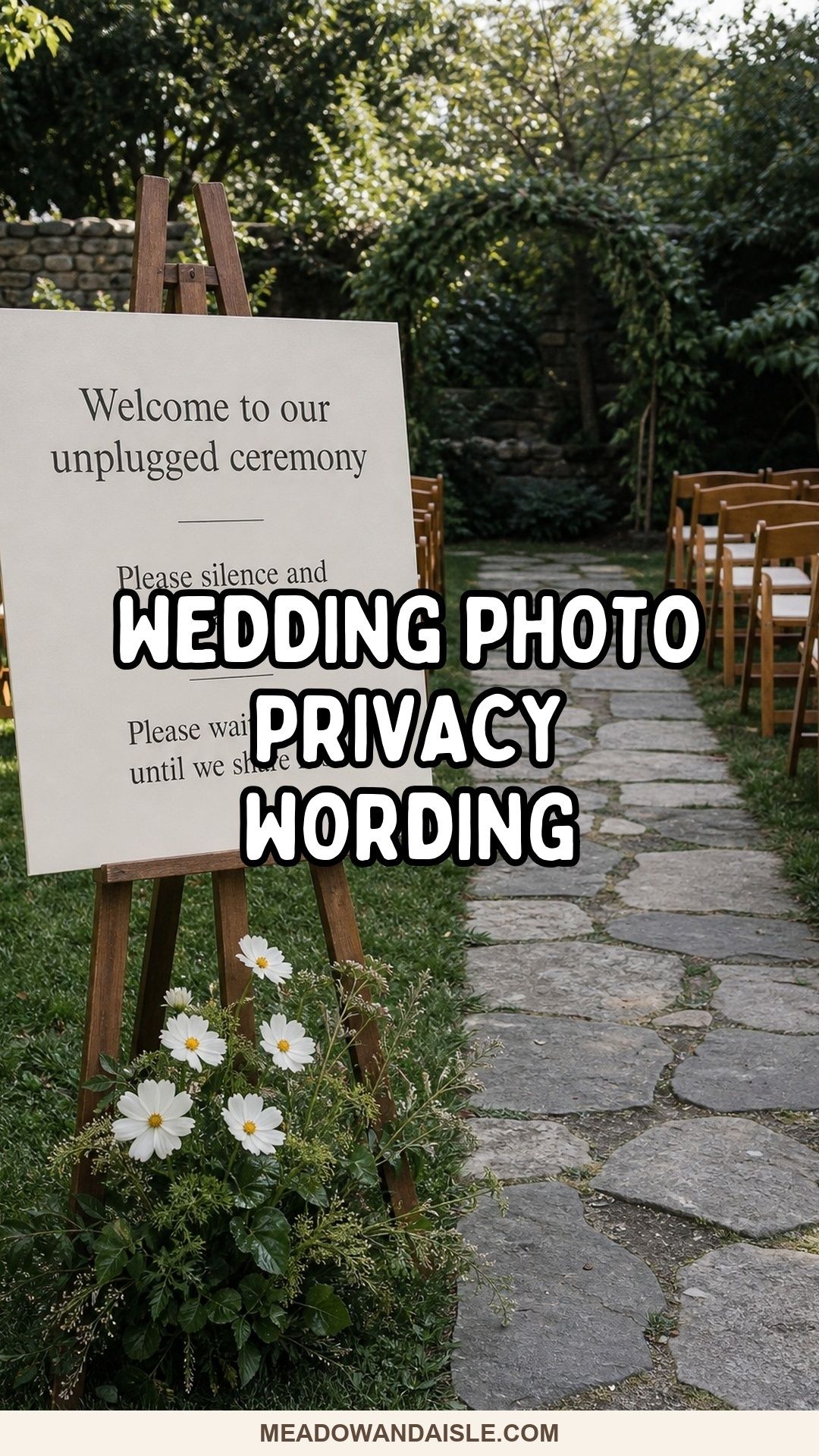
Phones away ceremony wording works well as: “Welcome to our unplugged ceremony. Please silence and tuck away phones so we stay fully present together. We will happily share photos after the celebration.” For a no-posting version: “We are so glad you are here. Please keep photos off social media until we share our first announcement. Thank you for protecting this moment with us.”
A sign works best as a reminder, rather than the whole policy. Guests who missed the website still get a reminder, but the sign should not be the only place the rule appears. Treat it as a gentle cue at the exact moment phones usually come out.
Let The Officiant Say It Out Loud
An officiant announcement is the most reliable ceremony reminder because every guest hears it at the same time. Ask the officiant to speak before the processional begins, while guests are seated and phones are still in hand. The tone should match your ceremony: gracious, simple, and not apologetic.
Officiant wording for an unplugged ceremony: “Before we begin, the couple invites you to be fully present with them. Please silence and put away phones for the ceremony. Their photographer will capture this moment, and they are grateful to share it with you in real life.”
For a full no-posting request, add one sentence: “They also ask that photos and videos stay off social media until they have had the chance to share their own announcement.” Spoken calmly, this sounds like normal ceremony housekeeping, not a lecture.
Offer A Private Photo Sharing Option
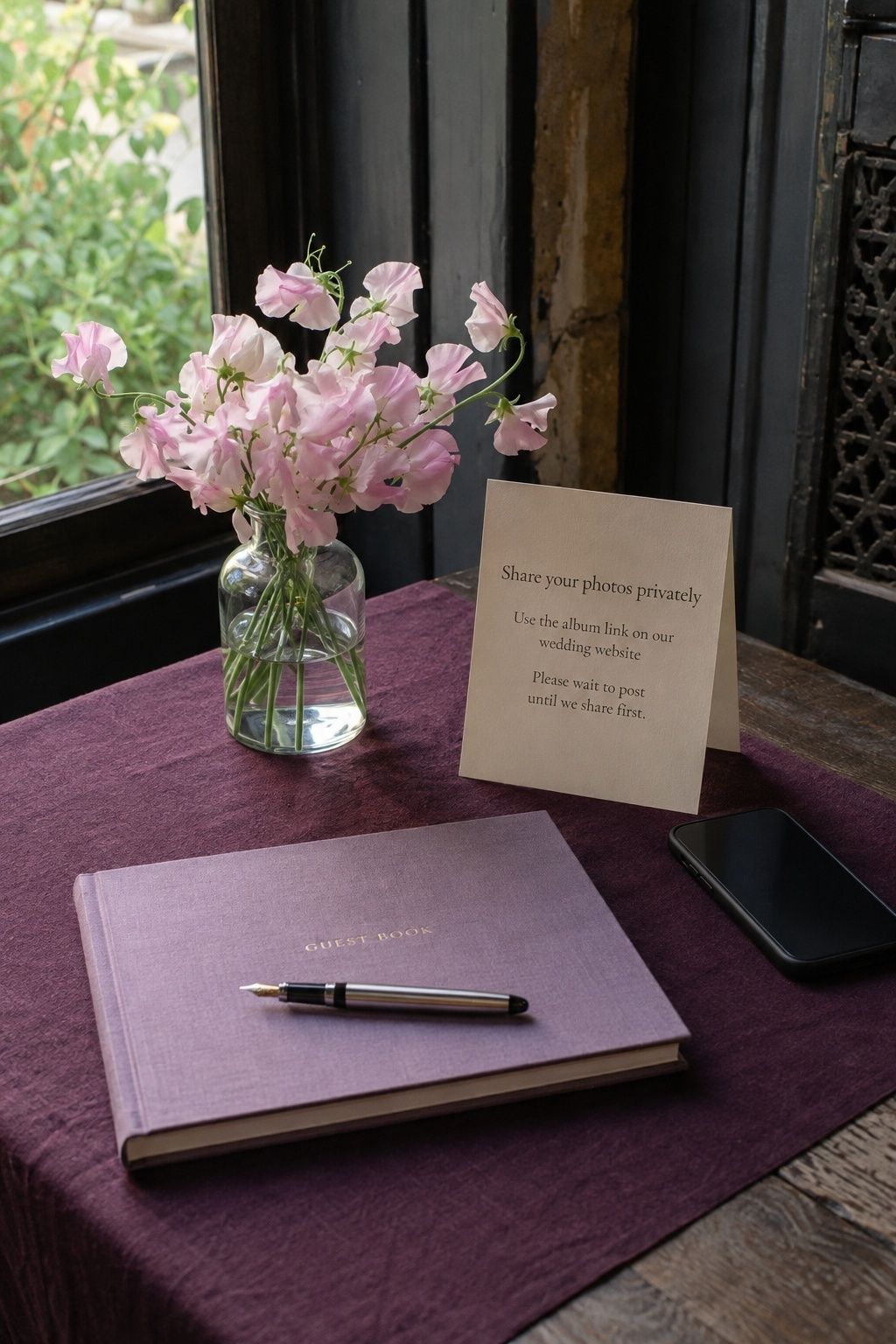
Guests are far more cooperative when they know where to send their photos. A private wedding photo album, shared drive, QR upload page, or closed gallery gives them somewhere to send the candid photos they are proud of. Without an alternative, “do not post” feels like a dead end. With one, it becomes “share here instead.”
Place the QR code on table cards, bar signage, the program, or a small card at the guest book. Label it clearly: “Upload your photos for us here.” If the album is private, say so. Guests who worry that their pictures will disappear into a public feed feel better knowing the couple will actually see them.
This approach works especially well for wedding guest photo sharing after the ceremony. Let guests take dance floor photos, detail shots, and group selfies, then redirect the sharing impulse into a private space. You get the candid record without losing control of the outward-facing one.
Tell Guests When Photos Are Welcome
Many couples accidentally write only the restriction. Better wording also names the opening. If phones are away only during the ceremony, say photos are welcome at cocktail hour and reception. If posting is paused only until your announcement, say guests are free to post after you share. If the entire event is private, say guest photos are for personal memories and the private album.
Clear permission keeps guests from guessing. “Please keep phones away during the ceremony; after that, take all the photos you like and upload them to our private album” feels warmer than “no phones.” “Please wait to post until we share first” feels more reasonable than “no social media” when the restriction is temporary.
This also protects your photographer. If guests know when phones come back out, they are less likely to lean into the aisle, hold screens above their heads during vows, or step into the recessional shot. The rule becomes part of the timeline.
Keep The Wording Kind But Direct
The best wedding social media wording sounds like the couple, not a courtroom. Avoid “strictly prohibited,” “violators,” “forbidden,” and “we demand.” Those words create tension before anything has happened. Also avoid making the request so soft that nobody knows whether it matters. “We would prefer” and “if possible” are easy to miss.
Choose language with a warm spine: “please keep,” “we ask,” “thank you for honoring,” “we are grateful,” and “until we share first.” That gives guests a clear action and a reason to cooperate. If the request is truly important, say it plainly. Kindness does not require vagueness.
A polished short version: “We kindly ask guests not to post wedding photos or videos to social media until we have shared our own announcement. Please upload any favorite candids to our private album instead.” It is brief, gracious, and easy to repeat across the website, sign, and program.
Handle Private Family Situations With Extra Care
Sometimes the request is not about mood at all. It is about people. A relative is ill, estranged, grieving, deployed, newly sober, in a custody situation, or unable to attend. A child appears in the wedding party with limited photo consent. A parent does not know certain news yet. Social media turns private complexity into a public timeline very quickly.
In those cases, do not over-explain in public wording. “We are keeping photos offline for family privacy reasons” is enough for the wedding website. Close relatives who need details should hear it privately. Most guests only need the action: enjoy the day, take personal photos where allowed, and keep them off public platforms.
If children are part of the concern, consider a full no-posting policy rather than asking guests to avoid only certain faces. Individual photo policing is too hard during a wedding. A blanket request is cleaner and kinder to everyone.
Ask Fast-Posting Family Directly
Every family has at least one person who posts before the appetizer arrives. If you already know who that is, do not rely on a sign. Send a loving direct message before the wedding: “We are asking everyone to hold wedding posts until we share first. I know you will be excited, so I wanted to say it directly. Please send us your photos in the private album instead.”
Make the ask personal without making it accusatory. You are not saying, “We do not trust you.” You are saying, “This matters enough that I want you to hear it from me.” People who love you usually want to honor the reason once they understand the reason.
If a parent or sibling is likely to receive guest questions, give them the exact sentence to repeat. Consistent language prevents improvisation that accidentally sounds harsher than the couple intended.
Avoid Public Confrontation On The Day
If someone ignores the request, the worst response is a public correction. Do not call them out during dinner, make a DJ announcement about “certain people,” or comment under the post where others see it. That turns a privacy issue into a relationship issue.
Choose one calm point person before the wedding: a sibling, wedding party member, coordinator, or close friend. Their role is not to monitor every phone. Their role is to handle obvious issues quietly if they come up. The couple should not spend the reception watching stories refresh.
A private text usually works: “Hey, the couple is keeping wedding photos off social until they announce. Would you mind taking that post down for now? They would love for you to upload it to the private album.” Short, specific, and calm is the whole trick.
Have A Plan If Someone Posts Anyway
Even with clear wording, someone still posts anyway. Decide in advance what is worth addressing. A blurry photo of centerpieces on a locked account rarely matters. A public ceremony video before you announce probably does. A photo showing a child, vulnerable relative, or private ritual deserves a faster response.
Your plan should include who contacts the guest, what they say, and when you let it go. Ask once with kindness. If the guest removes it, thank them. If they refuse, do not spend your wedding day escalating. Save any heavier conversation for later, when you are not in formalwear trying to enjoy dessert.
The goal is not perfect enforcement. It is reducing the chance of unwanted public sharing and giving yourself a calm path if it happens. A no-posting request is a boundary, not a guarantee.
Share Professional Previews Quickly
If your main concern is the first public image of the wedding, talk with your photographer about sneak peeks. Many photographers deliver a small preview set within a few days, and some offer same-day or next-day highlights. Knowing when those images arrive gives you a realistic posting window for guests.
Tell guests: “Please wait to post until we share our first photos after the wedding weekend.” Or: “We will share a few previews as soon as we receive them, then public posting is welcome.” That gives guests a finish line instead of an indefinite restriction.
If privacy is the reason, professional previews do not end the policy by themselves. Keep public posting closed and share photos only through a password-protected gallery or private family album when the privacy concern remains. The right timeline depends on what you are protecting.
Make Privacy And Presence Work Together
The warmest version of this request is not “hide our wedding.” It is “be here with us first.” Privacy and presence often strengthen each other. When phones stay away during vows, guests look at the couple. When posts wait until later, the couple gets to feel married before becoming content on everyone else’s feed.
Bring that energy into your wording. “We want to experience this moment with you before it goes online” feels human. “Please keep this day close until we choose to share it more widely” feels intimate. “Your presence matters more than your post” is firm without being sharp.
When guests understand that the request protects the feeling of the day, most will honor it. The ones who need reminders will at least have heard a consistent message.
Where To Communicate A No-Posting Request
A no-posting request should appear wherever guests naturally look for instructions. The website gives the complete policy. The sign gives the day-of reminder. The officiant gives the final ceremony cue. Table cards or QR cards give the private sharing alternative. Together, these touchpoints make the boundary feel normal.
Wedding Website FAQ
The website FAQ is the easiest place for full wedding website photo policy wording. Use a question such as “Are photos and social media posts okay?” Then answer in plain language. This lets guests who are looking for the dress code or schedule find the photo policy before they pack a tripod, plan a live stream, or create a hashtag.
Good FAQ wording: “We are having an unplugged ceremony, so please keep phones away during the vows. After the ceremony, personal photos are welcome, but we ask that nothing be posted publicly until we share first. A private album link will be available for guest photos.”
Details Card Or Invitation Insert
If the policy matters enough to affect the guest experience, include a short line with the invitation suite. Do not crowd the main invitation. A details card gives you space for dress code, transportation, RSVP, website, and photo privacy in one tidy place.
Keep the insert version short: “We kindly ask guests to keep wedding photos off social media until we share our announcement. More details are on our wedding website.” This points guests to the fuller wording without making the invitation feel stern.
Ceremony Entrance Sign
A ceremony sign catches guests at the most important moment. It should be easy to see from a few steps away, with one request and one thank-you. If you are asking for phones away, say that. If you are asking for no public posting, say that too, but keep the sign from becoming a dense policy sheet.
Sign wording: “Please silence and tuck away phones during the ceremony. We are grateful to share this moment with you fully present.” Add a second line for social privacy: “Please also keep photos off social media until we share first.”
Ceremony Program

A program earns its place because guests already hold it while they wait. Place a short phones-away ceremony wording line with the order of events, not hidden in tiny print. A program also feels less like signage and more like ceremony guidance.
Program wording: “During the ceremony, please silence phones and keep cameras tucked away. We invite you to be present for the vows and share in the celebration afterward.” If photos are welcome later but posting is paused, add: “Afterward, please share photos privately until the couple shares their announcement.”
Officiant Welcome
The officiant welcome is the final checkpoint. It reaches guests who missed the website, forgot the sign, or had their phone out for the processional. Ask the officiant to pause long enough for guests to actually silence devices and put them away.
Spoken wording: “The couple has asked that phones be silenced and put away for the ceremony so everyone here is fully present. They also ask that any photos from today stay off social media until they have shared their own announcement. Thank you for honoring that.”
Reception Table Cards And QR Codes
Reception cards are where the request becomes easy to follow. A QR code card says: “Share your photos with us here.” Under that, add: “Please keep posts private until we share first.” The guest gets an action, not just a restriction.
Put the QR code where people linger: table numbers, bar menus, guest book table, lounge area, or favor display. One sign at the entrance is easy to miss. A few quiet reminders during natural phone moments work better.
Welcome Party Or Rehearsal Dinner
If your closest guests gather before the wedding, mention the policy casually then. This is especially smart for wedding parties, siblings, parents, and friends who will be with you early in the day. A warm heads-up at the welcome party makes the wedding morning smoother.
Say: “One quick thing for tomorrow: we are keeping ceremony phones away and holding social posts until we announce. Please send us everything through the private album.” That is enough. Then move back to enjoying the night.
Wedding Social Media Wording To Adapt
Use these examples as starting points and adjust the warmth, formality, and strictness for your guest list. The best wedding social media wording sounds like something you would actually say. If a line feels too cute, too formal, or too intense, simplify it.
Soft No-Posting Wording
“We are so excited to celebrate with you. One small request: please hold off on posting wedding photos or videos publicly until we have shared our own announcement. We would love for you to send your favorite photos to our private album.”
This wording fits couples who are not banning phones and do not need a hard privacy wall. It asks guests to pause public sharing while still inviting them to document the reception.
Firm Privacy Wording
“For personal privacy reasons, please do not post photos or videos from our wedding on social media. Guest photos are welcome in our private album, and we will share official photos when we choose.”
This version is better for family sensitivity, children, private ceremonies, or couples who do not want a public wedding footprint. It is firm without sounding harsh because it explains the category of reason and gives guests an alternative.
Unplugged Ceremony Wording
“We invite you to be fully present during our ceremony. Please silence and put away phones while we exchange vows. Our photographer has the ceremony covered, and we are grateful to have your attention with us.”
This wording focuses on presence rather than control. It works for signs, programs, websites, and officiant scripts.
Photos Welcome But No Posting Wording
“After the ceremony, please take photos and share them with us through the private album. We only ask that photos and videos stay off social media until we have posted our announcement.”
This is the clearest answer for couples wondering whether guest photos are welcome without public posting. Yes, if that is your policy. Say where photos are welcome and where they should not go yet.
Family Privacy Wording
“We are keeping our wedding photos private for family reasons. Please enjoy the day with us and avoid posting photos or videos online. We will share a private gallery with loved ones after the wedding.”
This protects the reason without exposing the people involved. It is direct enough to matter and gentle enough for a wedding website or close-family message.
How Strict Should Your Photo Policy Be?
The right level of strictness depends on what you are protecting. If the main issue is ceremony presence, an unplugged ceremony with open reception photos is usually enough. If the issue is announcement control, a temporary posting pause until your own announcement works well. If the issue is child privacy, family safety, religious restrictions, or a private legal situation, a full no-posting policy is easier for guests to understand and easier for your point person to repeat.
Ask yourselves three questions before choosing the final wording. First, would one public photo create a real problem or simply feel annoying? Second, do guests need to put phones away, or do they only need to keep photos offline? Third, when does the restriction end? Couples who answer those questions before writing usually sound calmer because the rule has clear edges.
If you are still unsure how to ask guests not to post wedding photos, choose the smallest rule that protects the real concern. A smaller rule is easier to honor. A clear rule is easier to remember. A kind rule is easier to repeat without embarrassment.
FAQ
How Do You Ask Guests Not To Post Wedding Photos?
Ask guests not to post wedding photos by telling them before the wedding, giving a short reason, and offering a private sharing option. Put the request on your wedding website, repeat it on a ceremony sign or program, and have the officiant say it before the ceremony begins. Keep the wording warm but clear: “Please wait to post until we share first.”
Is It Rude To Ask Guests Not To Post Wedding Photos?
No, it is not rude to ask guests not to post wedding photos when the request is communicated kindly and early. Couples often make this choice for privacy, presence, children, family circumstances, religious reasons, or announcement control. It feels most gracious when guests still have a way to share photos privately with the couple.
What Should You Put On A Wedding Website About No Social Media?
Put the full no-social-media policy in the wedding website FAQ or details section. Say whether phones are away for the ceremony, whether personal photos are welcome later, when public posting is allowed, and where guests should upload private photos. A simple version is: “Please keep photos off social media until we share our announcement.”
How Do You Word An Unplugged Ceremony Sign?
Word an unplugged ceremony sign with one warm request and one reason. For example: “Welcome to our unplugged ceremony. Please silence and put away phones so we stay fully present together. Our photographer will capture the ceremony, and we are grateful to share this moment with you.”
Can Guests Take Photos But Not Post Them?
Yes. Guests take photos but do not post them when that is the policy you set. Make the distinction very clear: phones away during the ceremony, photos welcome at the reception, and no public posting until the couple shares first. A private album or QR code shows guests where their photos should go.
What Do You Do If A Guest Posts Anyway?
If a guest posts anyway, ask one trusted person to contact them privately and calmly. The message should focus on the action: “Would you mind taking that down until the couple shares first?” Avoid public confrontation. If the guest removes it, thank them. If they refuse, let the issue wait until after the wedding day unless safety or child privacy is involved.
Final Thoughts
Asking guests not to post wedding photos does not have to sound harsh. The kindest approach is clear, early, and generous: tell guests what you are protecting, explain when phones or photos are welcome, and give them a private place to share what they capture. Most people are happy to honor a request that feels personal, reasonable, and easy to follow.
A phone-free ceremony still protects the feeling of the room.
Last update on 2026-10-04 / Affiliate links / Images from Amazon Product Advertising API