

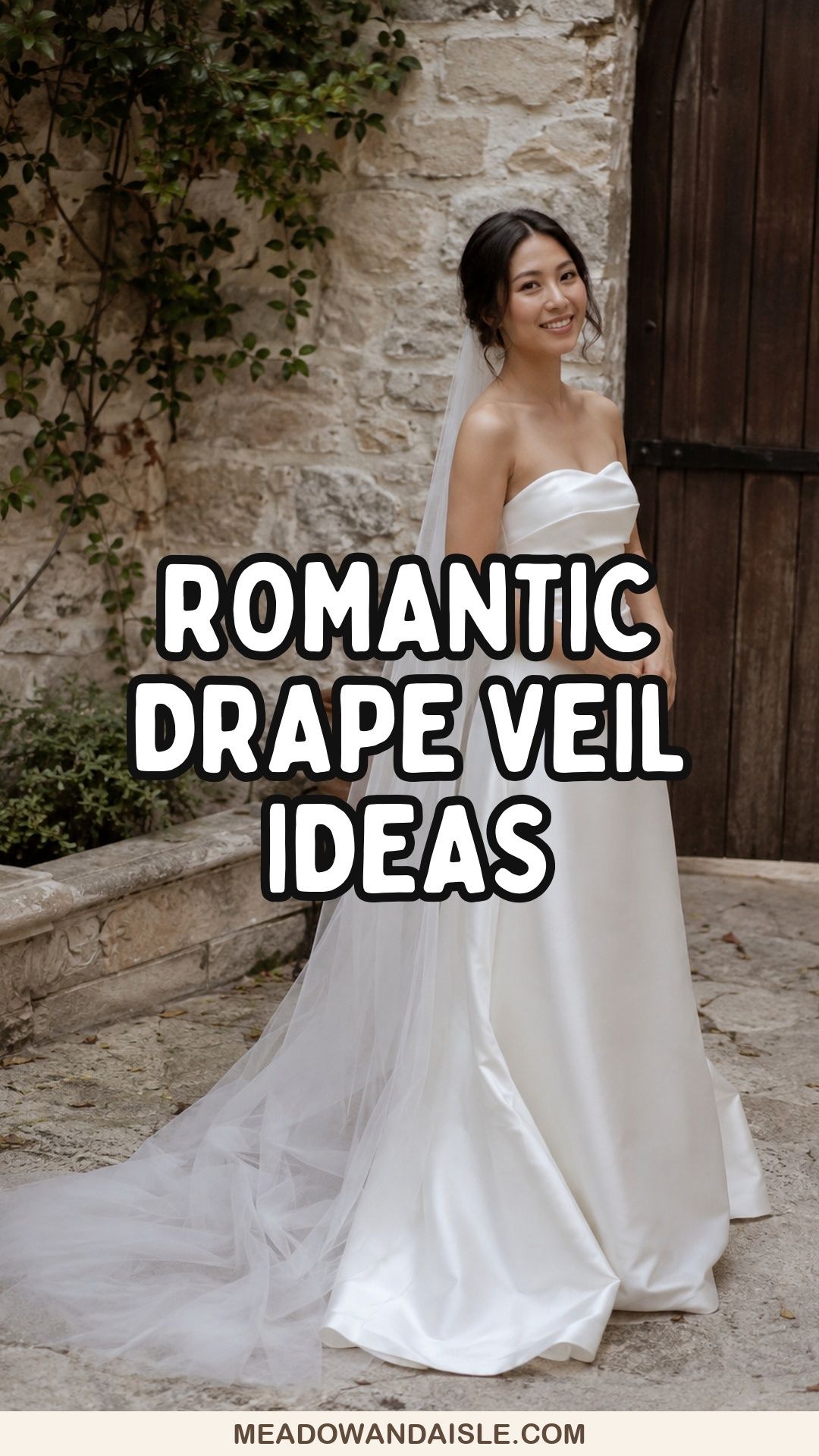
A drape veil looks best when you choose where the fabric starts before you choose the veil itself. Side combs show off your hair, a low bun gives a steady anchor, shoulder points leave your head free, and a Juliet cap frames your face. Test the weight on your real hairstyle before the wedding morning.
Most brides shop for a drape veil by length and lace, then find out at the hair trial that the comb has nowhere to grip. These drape veil wedding ideas start one step earlier, with the spot on your head or shoulders where all that fabric is going to hang, because I spent about 15 years in kitchens learning that anything untested at full weight falls over during service, and tulle is no different. The full picture is in bride hairstyles with flowers ideas.
Every style below comes with what it needs from your hair, your neckline and the room you’re getting married in. You’ll find a test for wind and hugs near the end, plus an answer to the question nobody asks until the night before: who takes this thing off, and where does it go?
Recommended Drape Veil Essentials
Veils, combs and the steamer that saves tulle from its suitcase creases, all in one spot.


Recommended blogs to read:
- Cape Veil Wedding Ideas for a Soft Veil Alternative
- Mermaid Drape Wedding Dress Ideas for Soft Sculpted Drama
- Red Veil Wedding Ideas for a Little Ceremony Drama
- Statement Veil Wedding Ideas That Make the Entrance
- Juliet Veil Cap Wedding Ideas for Old-Soul Romance
What Makes a Veil a Drape Veil?
The word describes how the fabric hangs. A drop veil falls in one smooth sheet from the head, a side-comb version falls from two anchors, a cape-like version begins at the shoulders (much like these cape veil wedding ideas), and a Juliet drape gathers around the crown before it falls back.
Pick your starting point first and most of the other choices make themselves. Side anchors leave more hair on show, shoulder points keep your head free, and a high neckline wants something sheer that won’t argue with the dress.
| Drape veil style | Strong pairing | Fit detail |
|---|---|---|
| Side-comb veil | Loose waves, low buns, open backs | Balance both combs before portraits |
| Juliet-inspired drape | Vintage gowns, lace, soft curls | Keep the crown smooth and light |
| Cape-like shoulder drape | Sleek dresses, short hair, high buns | Test arm motion and removal |
| Minimal sheer drape | Simple satin, crepe, square neck gowns | Match ivory tone in daylight |
| Chapel-length drape | Garden vows and gentle aisle motion | Assign one attendant for grass or stone |
How Do You Wear a Drape Veil With Your Hair and Dress?
Start from whatever will be holding the weight. For most brides that’s either two combs or a bun, and the dress decides how much veil you can get away with.
1. Two-Piece Side-Comb Drape Veil
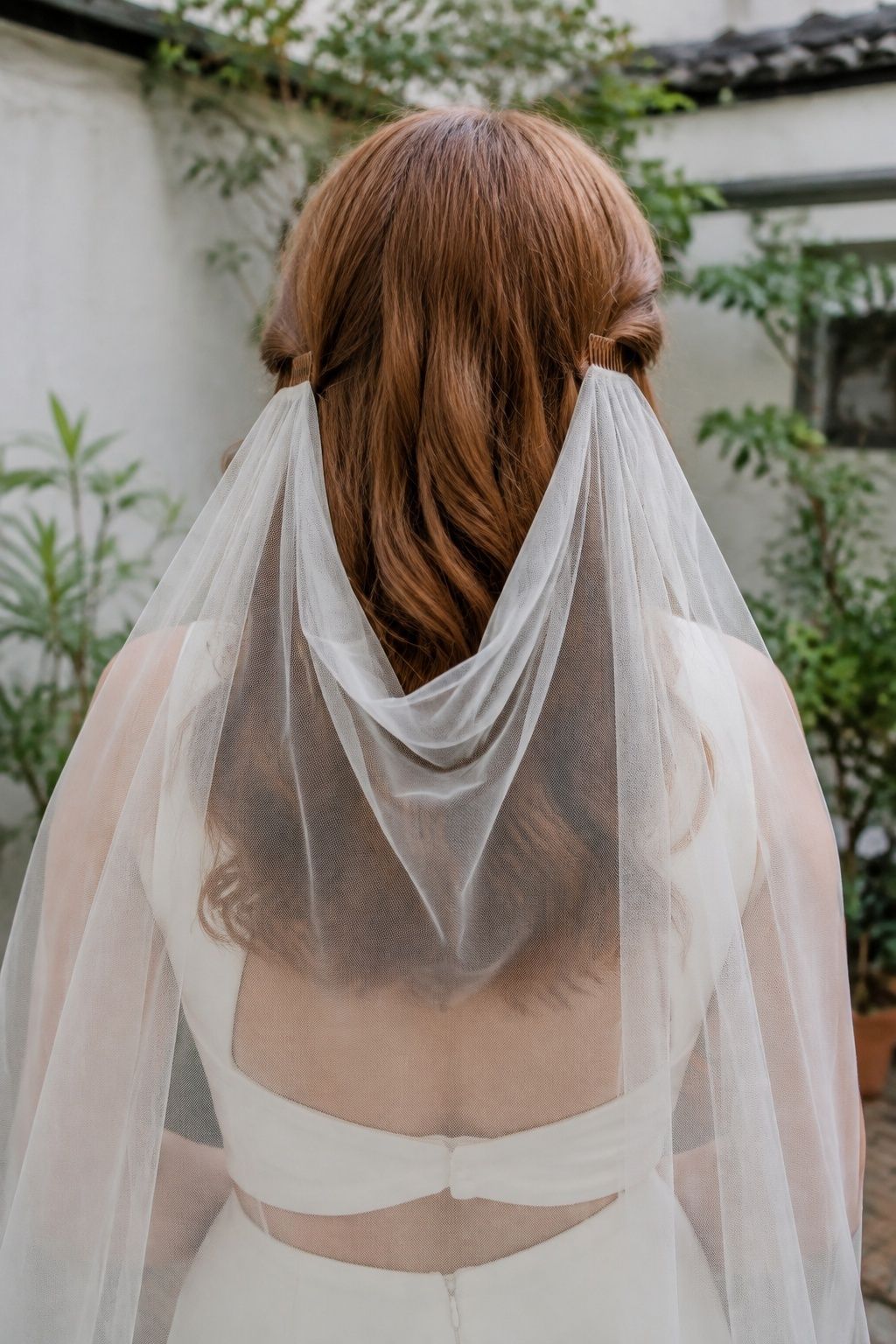
Two combs split the weight, which is good news if you have fine hair or you’ve ever had one big comb slowly slide down the back of your head during something important. The fabric falls from each side and dips in a soft curve behind your neck, a bit like a scarf, and your hair stays on show the whole time, which is the entire reason to pick this one over a regular veil.
Set both combs at exactly the same height and let the center dip on its own, because the moment you tug it straight you lose the curve you paid for. An open back like that low cutout is a lovely place for the dip to land.
At your hair trial, walk, turn your head and hug someone (a tall friend is ideal). If a comb shifts, ask for a tiny hidden braid under each one so it has something to bite into.
2. Soft Tulle Drape Veil With Low Bun
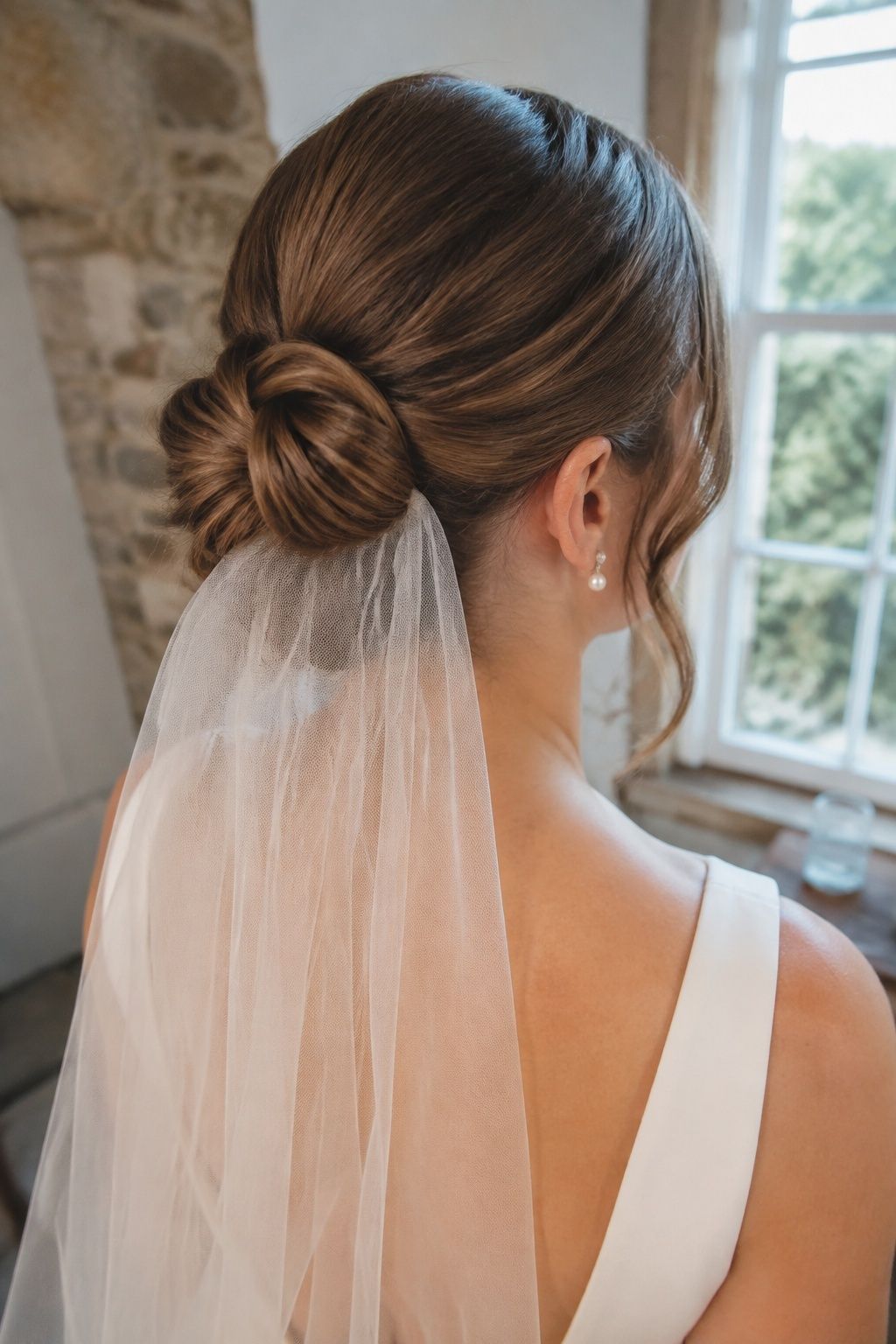
A low bun is the most reliable anchor a drape veil can have, since it sits right where the weight wants to be and your stylist can pin into something solid. It also keeps your face completely open, and for a bride who’d like to see her partner properly during the vows, that matters more than any lace. You can start the veil above the bun, tuck it lightly under, or pin it at both sides.
The fabric is where people go wrong. Stiff tulle springs outward and crowds a neat bun like that sleek twisted one, while soft tulle or English net just falls, and falling is the whole point of this style. If you buy online, ask whether the veil is soft or standard tulle before you pay, and hold it up by one corner when it arrives. It should collapse, without any drama at all.
3. Drape Veil With Clean Satin Gown
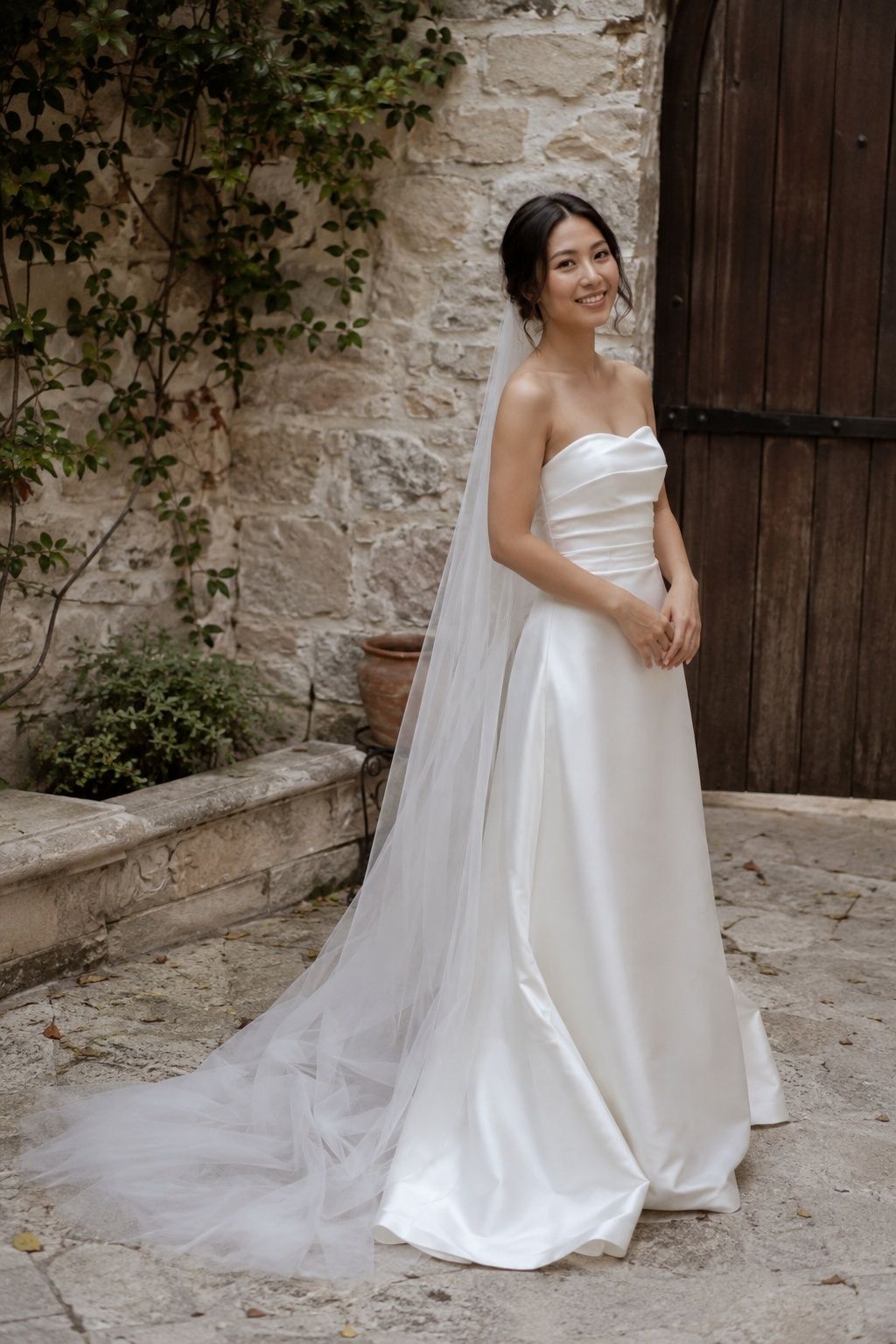
Plain satin gives a veil room to be the interesting part. With nothing on the bodice to compete, all you see is smooth fabric against sheer fabric, and that contrast does the styling for you without a single bead or pearl involved. Ask yourself one question about the train. If your gown has a long one, like the pooled satin here, choose a clean veil edge so you aren’t dragging two decorated things across the floor (or a courtyard, where the stone will have opinions). If the dress is narrow and simple, you can go wider on the veil and get some ceremony presence without changing the slim shape of the gown. And check the color against the satin in daylight, because satin reflects light and tulle doesn’t, which can make the same ivory look like two different ivories.
Which Drape Veil Styles Sit Closest to the Body?
These three skip the usual comb at the back of the head, which helps if your hair is short, your scalp is sensitive or you simply hate having anything pulling on you for eight hours.
4. Juliet-Inspired Drape Veil
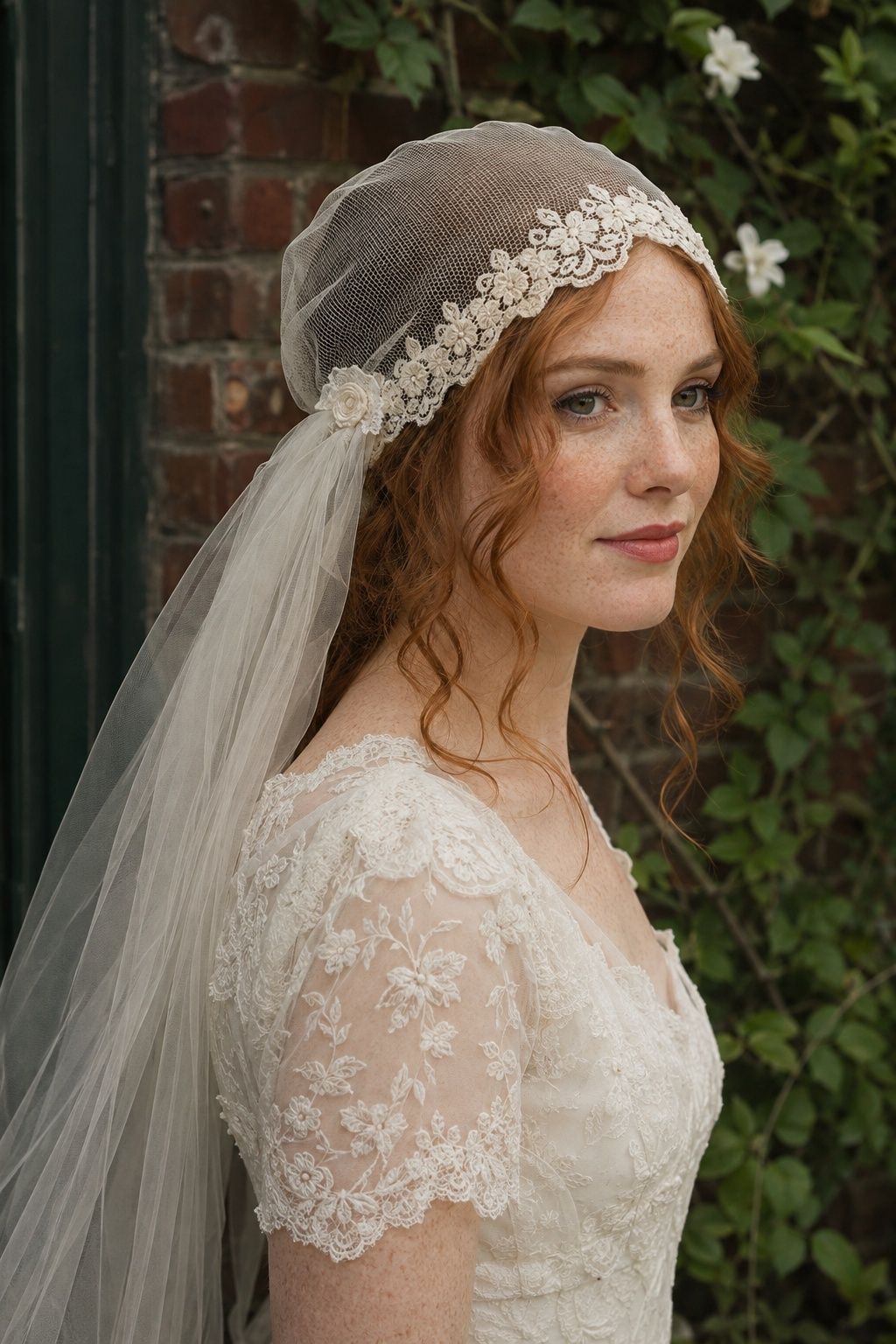
If you love old movies, here’s your veil. A Juliet cap sits close around the crown and the fabric falls back from there, which suits lace sleeves and soft curls like nothing else, and that scalloped lace edge across the forehead is what gives it the vintage feeling.
The mistake to avoid is fit. Too tight and it looks like a costume, too loose and it slowly travels during your vows while everyone pretends not to notice. Have your hair set first, with a little volume at the crown, and pin the cap into that base at the sides. Bring your earrings to the trial as well, since a cap this close to the face leaves very little space for anything big and dangly.
5. Cape-Like Drape Veil Over Shoulders
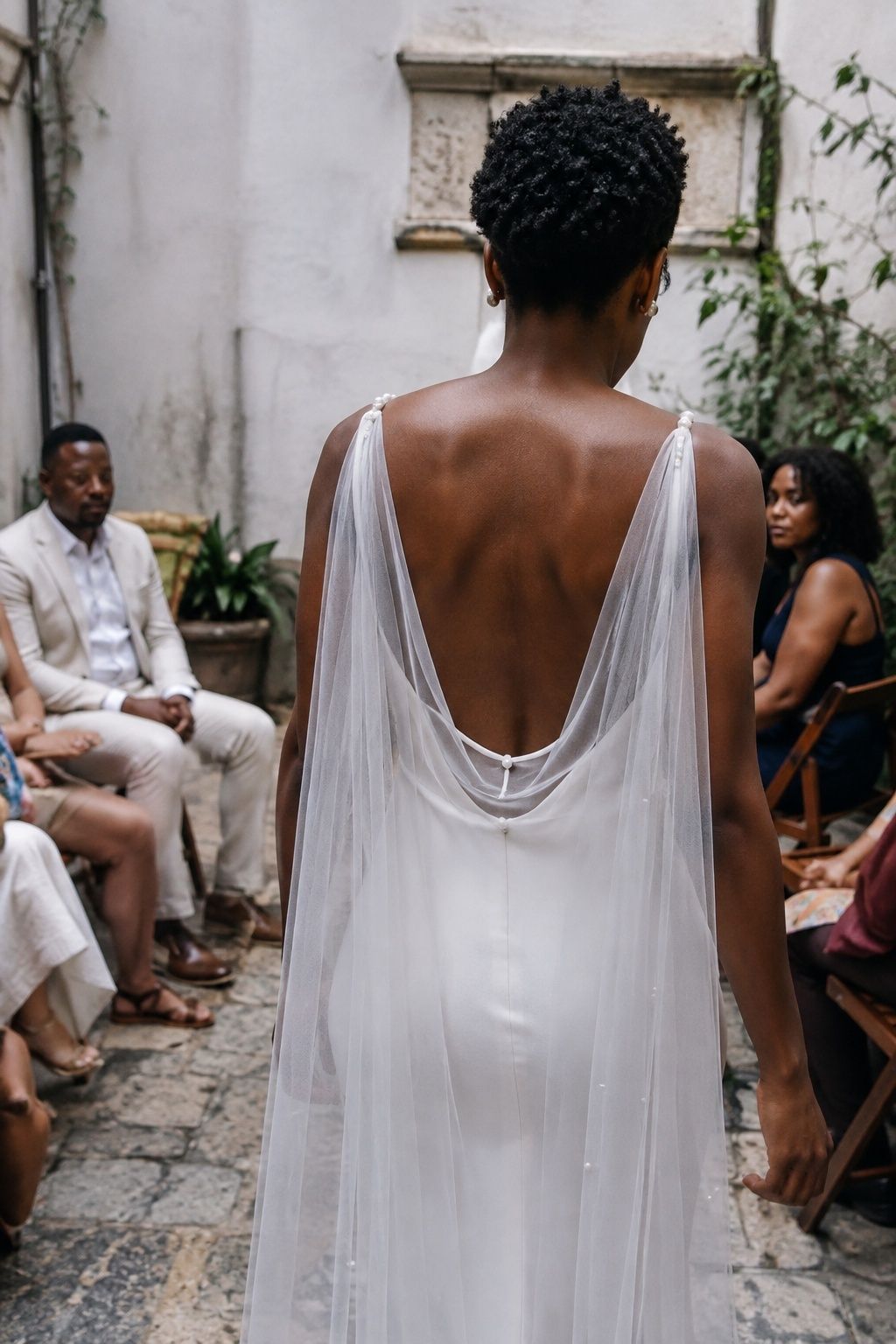
Short hair, natural curls or a head that refuses to wear combs? This is your answer, because a cape-like drape attaches at the shoulders, the straps or the back neckline, and your head stays completely free. Seen from behind, the sheer fabric swoops across the low back, so the guests sitting in those aisle seats get the best view of the day.
It needs a tailor, though. A long veil hanging from delicate straps will pull them down over a few hours, so ask for hidden snaps or loops stitched into a spot that can carry the weight.
- Bring the veil to your dress fitting so the tailor can test the fabric on the real straps.
- Lift both arms and hug the seamstress (she’s seen it all).
- Sit down, because sitting is when shoulder veils pull hardest.
- Ask for removable snaps if you want a clean dress for dancing.
6. Drape Veil With Pearl Pins
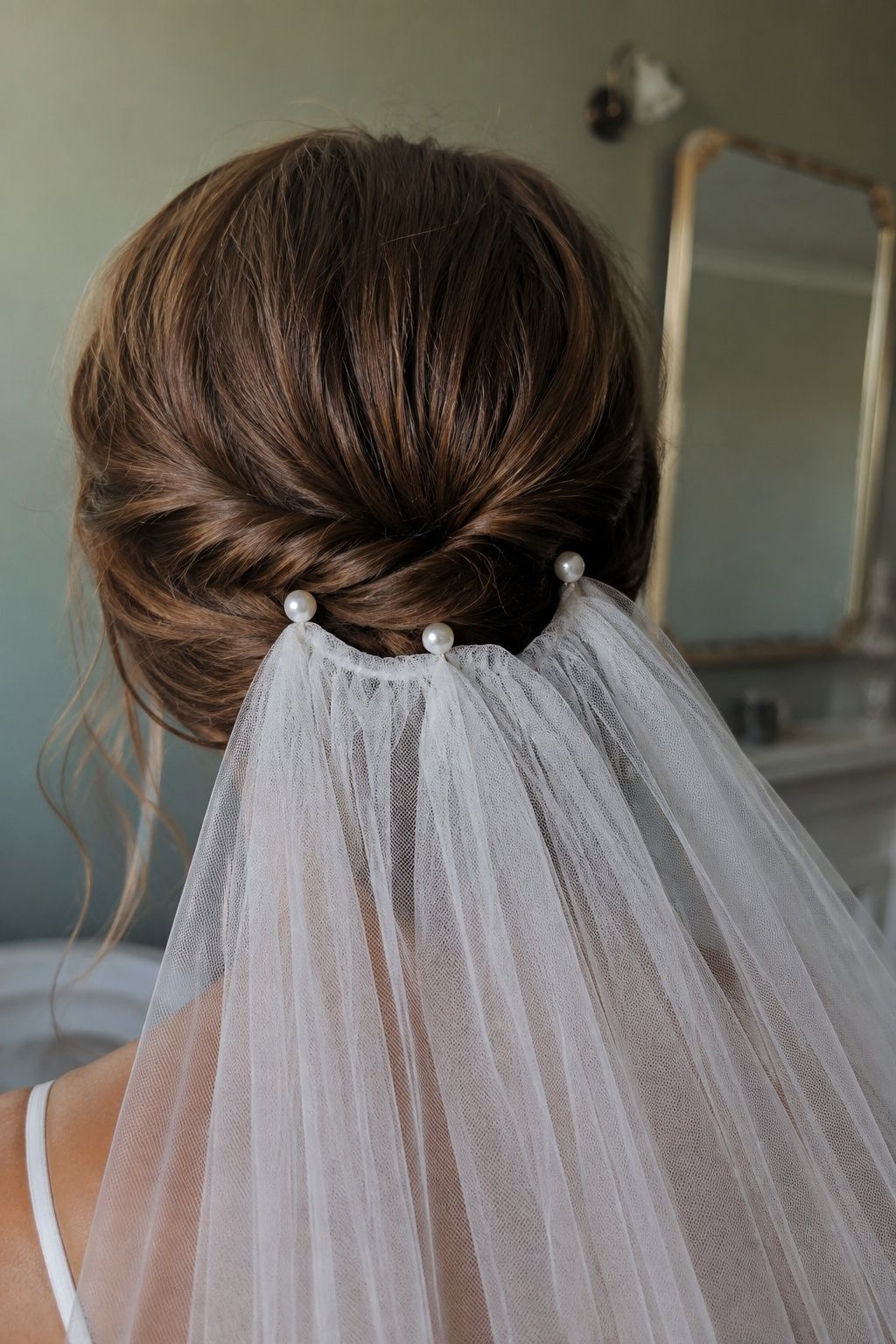
Pearl pins solve a small but annoying problem, which is that combs and bobby pins are ugly, and from behind, during the ceremony, the back of your head is all anyone is looking at. Three little pearls along a twisted low bun turn the attachment into a detail. Scale is the thing to get right. Tiny pearls look airy against sheer tulle and bigger ones hold their own on satin, but a row of heavy pearls will tug on fine hair by the time dinner arrives. If your veil already has pearls scattered on it, skip the pearl pins and use a plain comb. Pearls on pearls on pearls starts to look like somebody lost a necklace.
What Length of Drape Veil Suits Your Venue?
Match the veil to the floor you’ll be walking on. A short one goes anywhere, and a long one needs a person.
7. Shoulder-Length Drape Veil For A Civil Ceremony
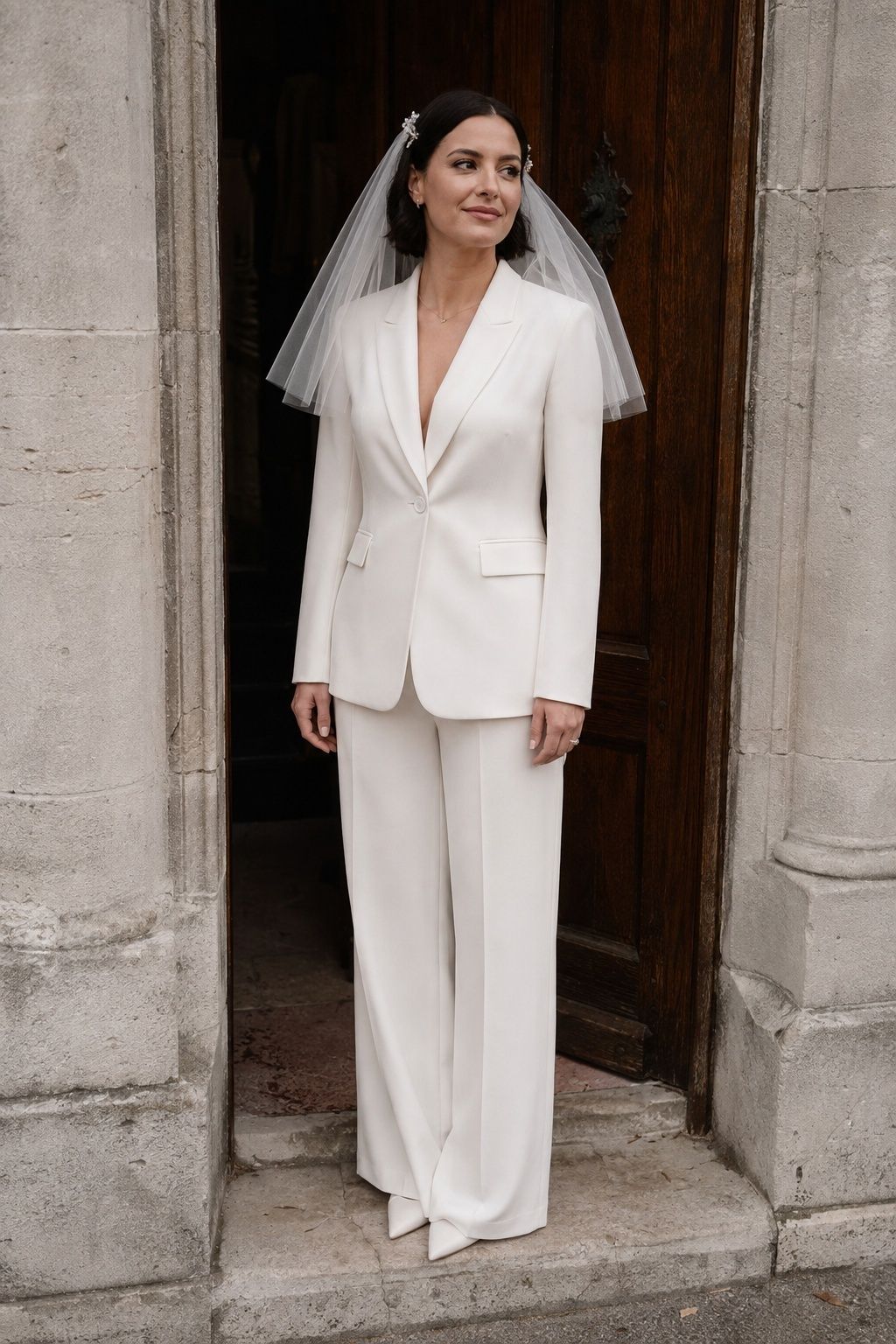
A registry office or city hall has no aisle to speak of, there’s usually an elevator involved, and you may well be taking a taxi to lunch afterward in the same outfit. A shoulder-length veil gives you the bridal signal in the photos without any of that being a problem, and with a white suit like this one it does a big job, since the veil is the bit that tells strangers on the street you’re the one getting married today.
Ask for it to end at a spot that flatters your shoulder or upper arm, and away from any sleeve detail. A clean, plain edge usually looks more modern at this length than lace does, and it costs less too, which I always enjoy.
8. Chapel-Length Drape Veil For Garden Vows
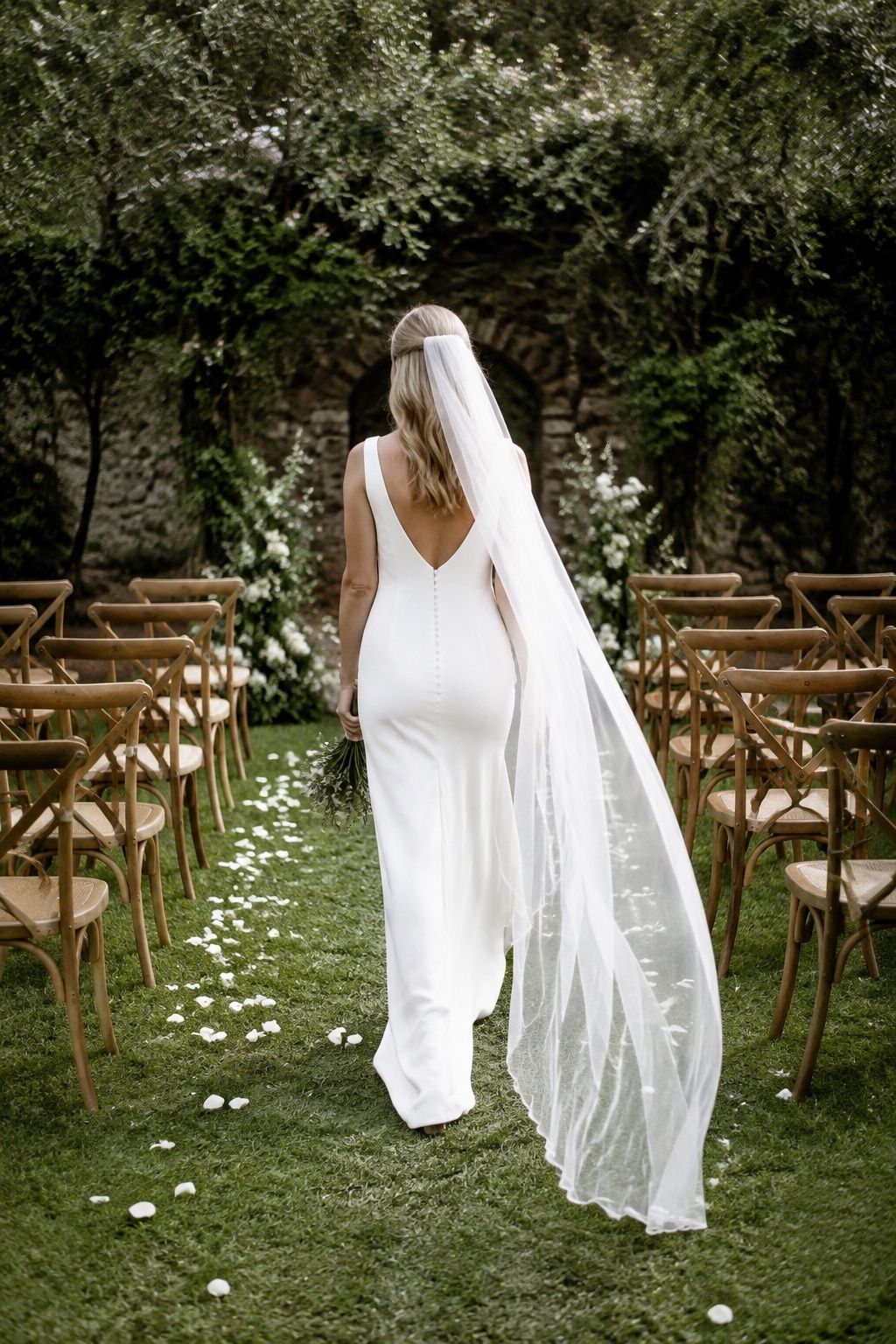
Chapel length gives you the trailing shot down the aisle without the full-time staffing that cathedral length demands, and one friend can lift it between photo spots. On grass, that really counts, because anything longer picks up petals, damp and small insects with enthusiasm.
Outdoors, the wind makes the decisions. Fine tulle will fly forward straight into your face, and heavy lace edges can snag on the lawn, so go and stand outside in the veil before the day, on a breezy afternoon if you can get one.
Tiny weights sewn into the hem help a lot, and a slightly narrower cut helps even more if your garden is on a hill or near open water. Here in Finland we get about one calm day per summer, so I may be biased about this.
Which Necklines and Hairstyles Need the Most Help?
Strong necklines and loose hair both change where a veil can sit. Each of these needs one small adjustment.
9. Drape Veil With Square Neck Dress
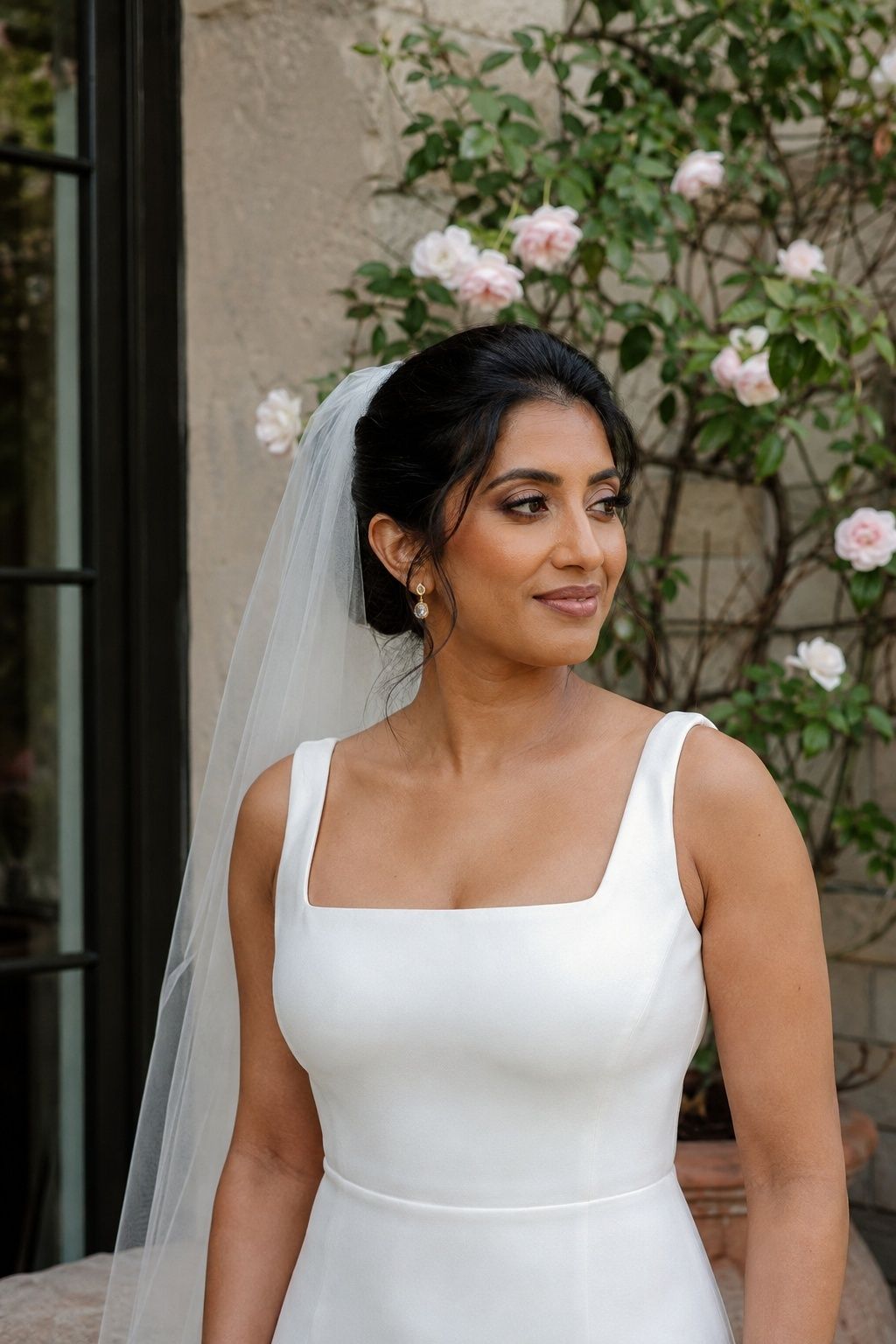
A square neckline is a straight, graphic line, and the softness of a drape veil is what stops it from looking severe. The danger is laying fabric across that line and hiding the one thing that makes the dress special, so three small placement rules matter here more than the veil itself:
- Keep the combs behind your ears, well back from the face.
- Let the fabric fall behind the wide straps so your collarbones stay clear from the front.
- For a shoulder-attached version, have it fixed just outside the straps.
Those pale pink roses behind her are a good reminder too, since a neckline this clean needs little more than simple drop earrings.
10. Draped Veil With High Neckline Gown
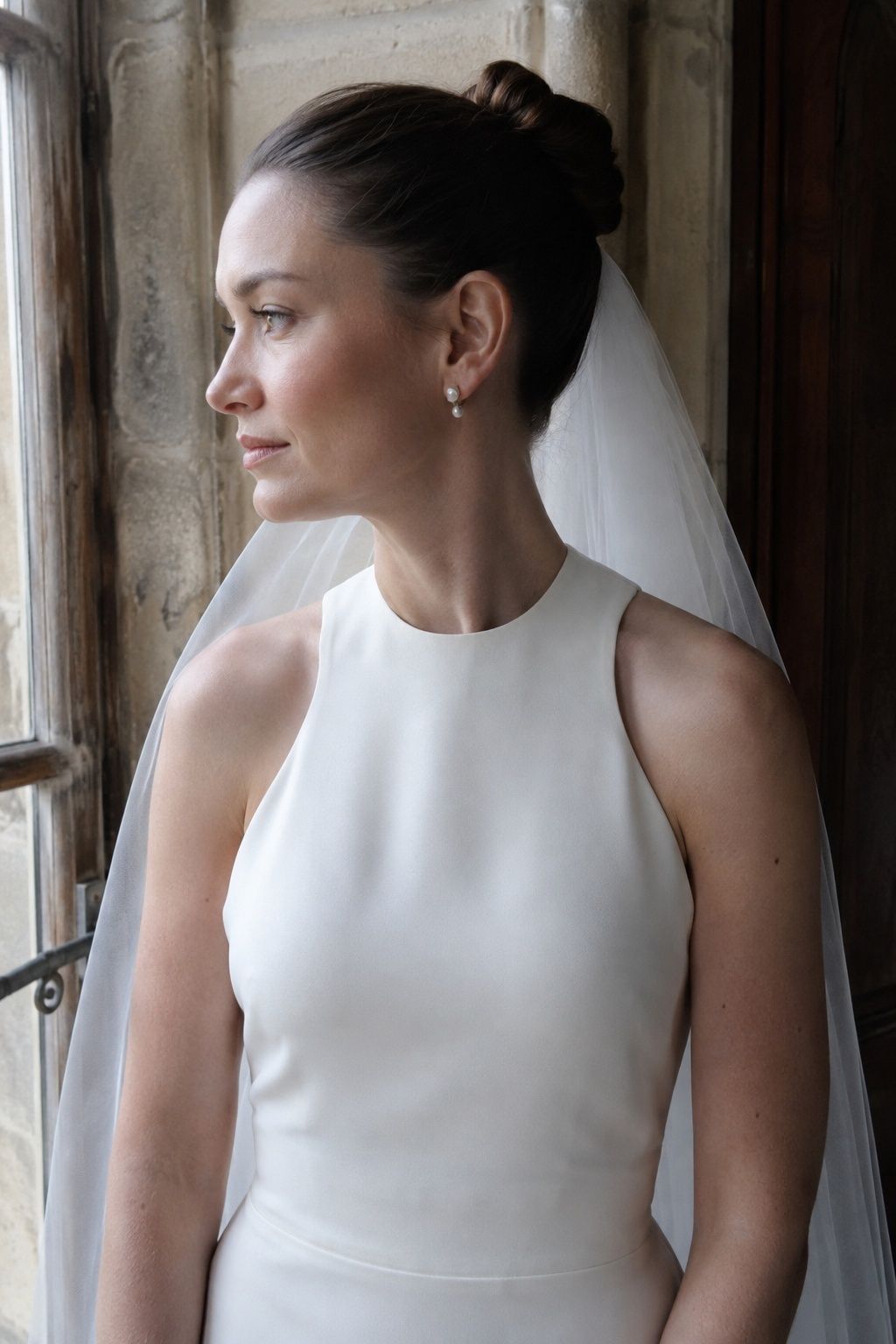
With a high neck, the dress has already taken over the area around your face, so whatever you add there will show immediately. The veil’s job is to add air at the back and nothing at the front. Skip heavy lace near your throat unless the gown is very plain. A narrow sheer drape set behind the shoulders opens up as you turn, which gives the photographer something lovely from the side while the clean neckline stays in charge from the front. A high bun like this one helps, because it lifts the hair off the collar, and it also gives you a good spot higher up to start the veil if you’d like a bit more drop behind you.
11. Drape Veil With Loose Waves
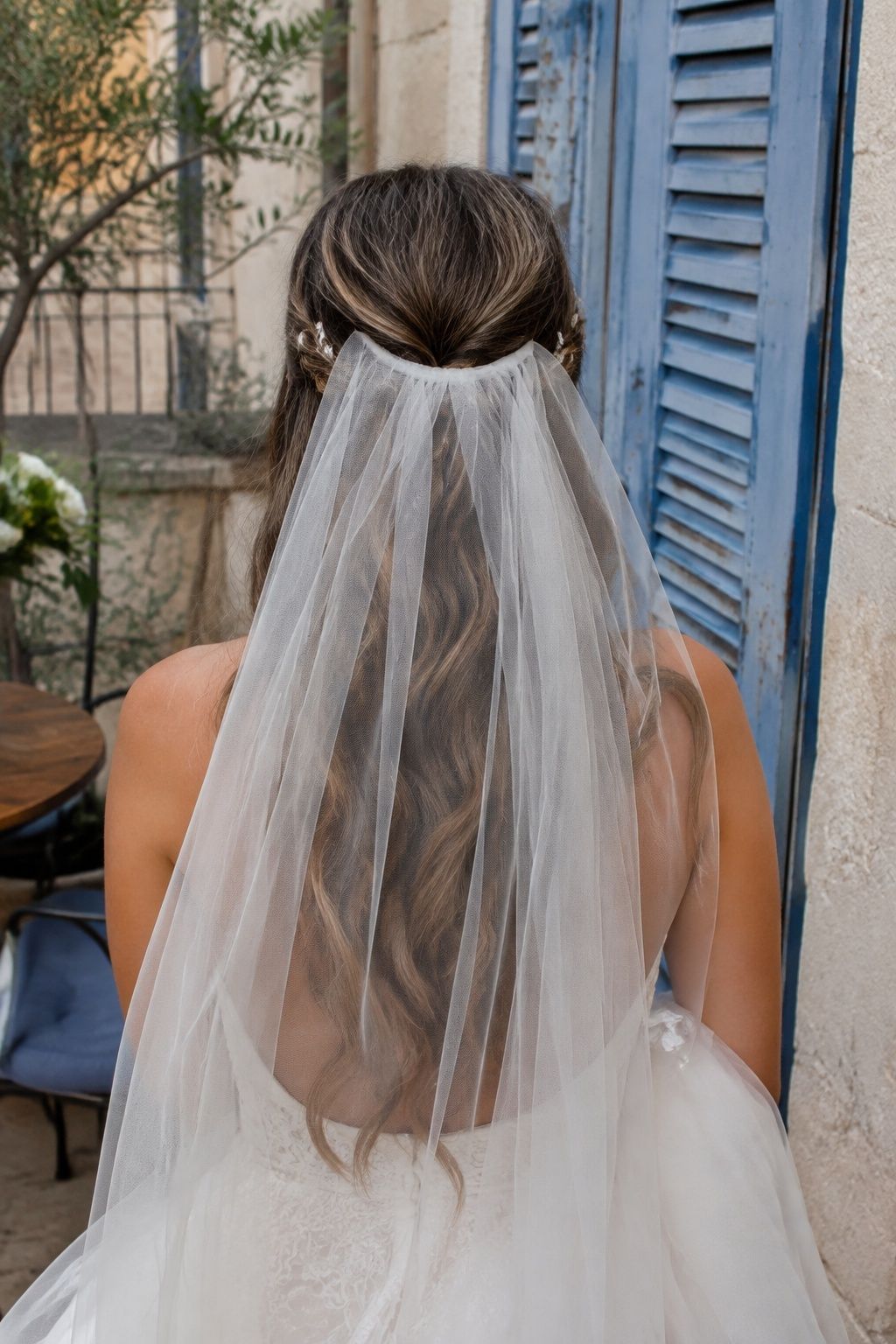
Does a veil work with your hair down? Yes, but loose hair gives a comb nothing to hold, and a veil sliding off mid-reception is a classic complaint on wedding forums. Your stylist needs to build a little hidden structure under the waves, usually a small braid or a pinned section at the crown, which is why half-up styles like this one are such a safe bet.
Ask them to test the veil after the waves have relaxed for an hour, and resist judging it the moment your hair is finished. Fresh curls hold anything. Tired curls at 4 pm are the real exam, and a side-comb drape is especially kind to them because your hair still shows between the panels.
How Much Detail Does a Drape Veil Need?
Less than you think, and it depends on how long you plan to wear it. Here are four ways to decide.
12. Minimal Sheer Drape Veil
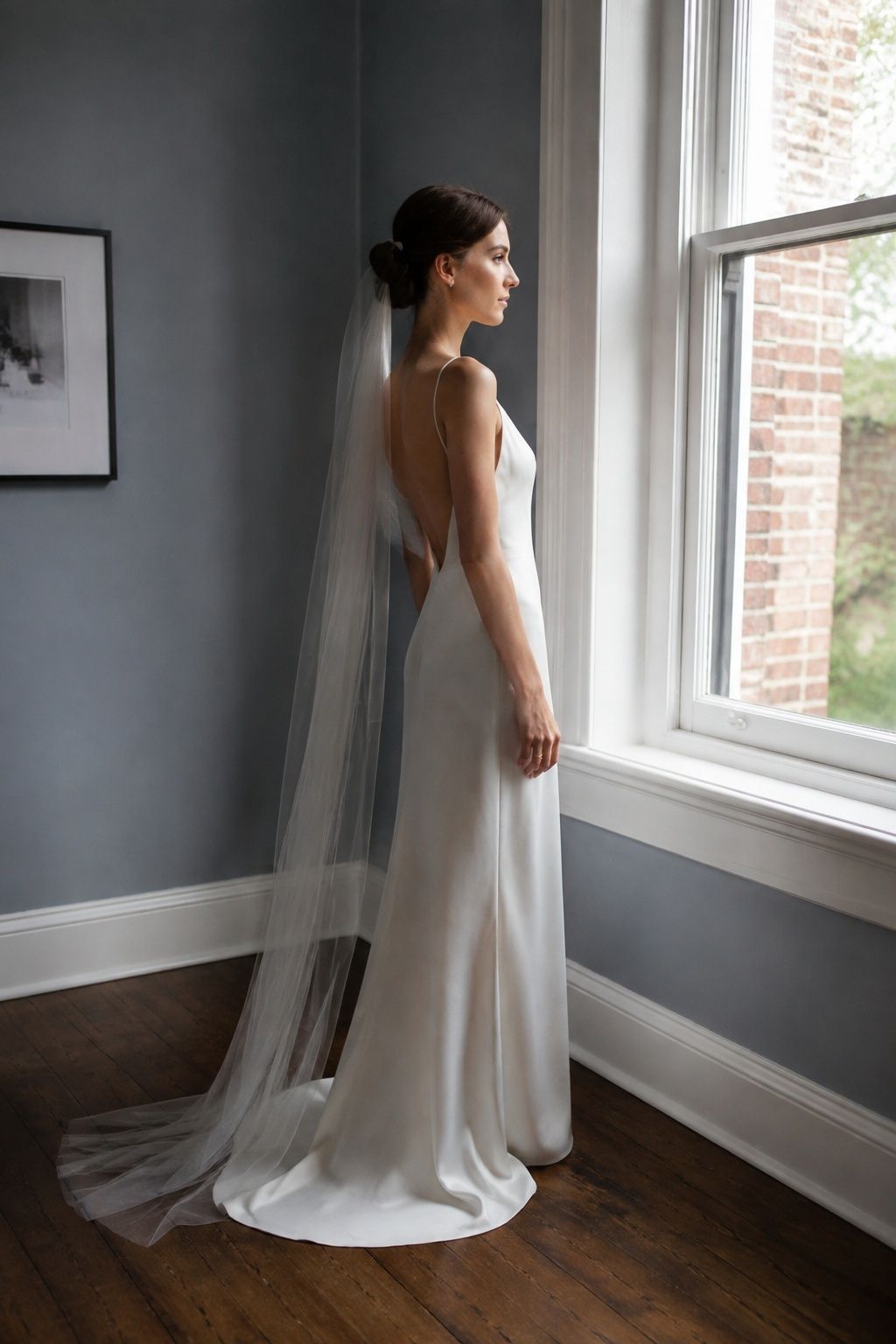
For a bride who likes the emotion of a veil and none of the decoration, a plain sheer drape is nearly invisible until the light hits it, and then it’s the prettiest thing in the room. That window light on the fabric here is doing all the work, and it costs you nothing extra.
With no trim to hide behind, color matters most. White, diamond white, ivory and champagne tulle all shift against a gown, and the wrong one can turn gray or faintly blue next to your dress.
Hold the veil against the fabric in daylight and again under indoor lamps, and choose the one that seems to vanish. Then be nice to it, since sheer tulle shows every crease (hence that steamer in the Essentials).
13. Floral-Edged Drape Veil
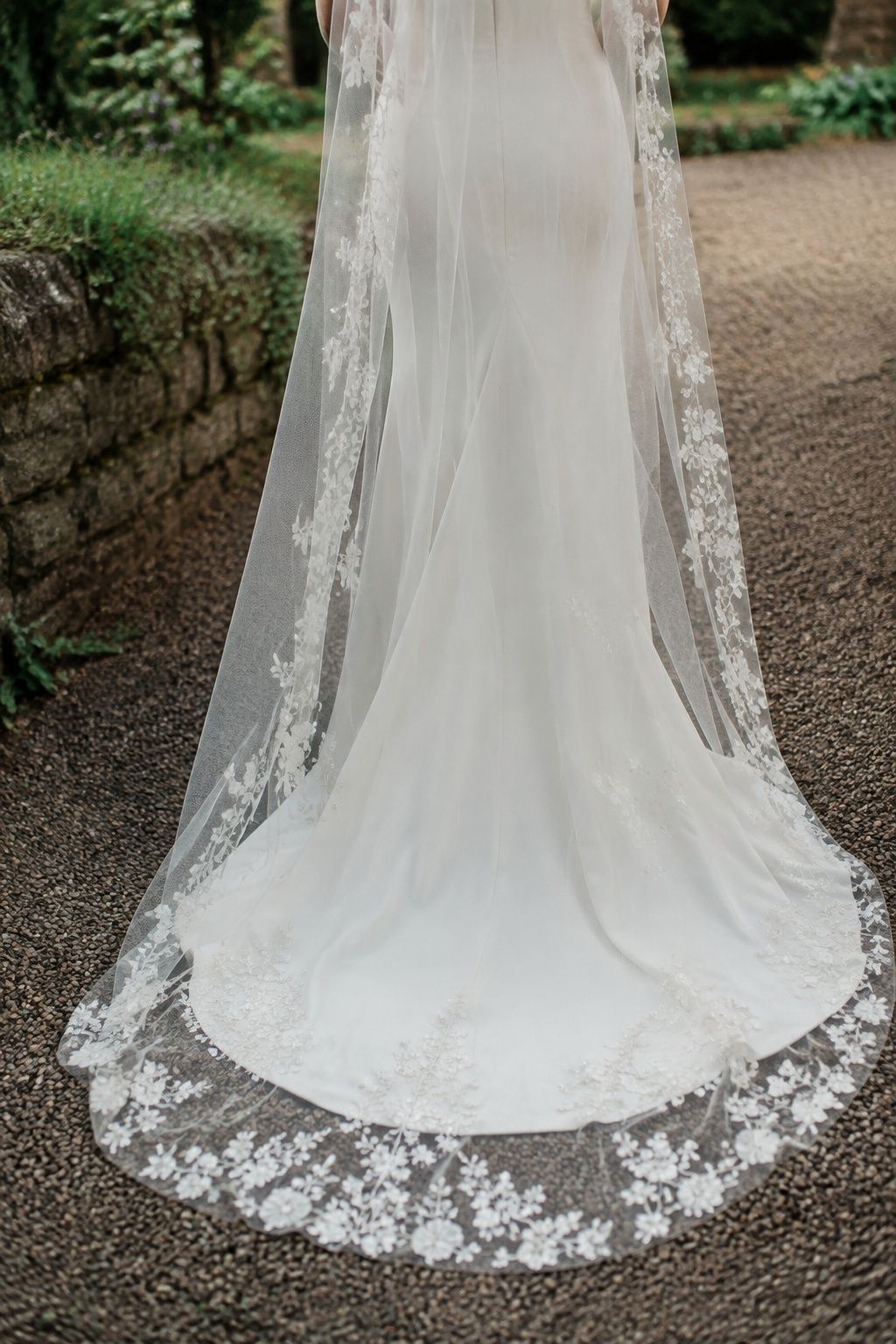
Lace flowers along the hem put all the detail at floor level, so your face stays clean up top and the guests get a treat as you walk past. That wide scalloped border spreading out over the gravel is why people fall for this style, and it suits a garden wedding very well, though gravel and lace do need a friend walking behind you to lift the edge at corners. Watch the weight. A heavy border pulls a soft veil backward, and if your attachment point is a single delicate comb you’ll feel it all day, so a floral edge usually needs two combs or a firmer base. If your dress already has floral lace, pick a lighter trim that echoes the size of the flowers, rather than trying to match every petal, because matching lace from two different makers almost never works.
14. Drape Veil With Reception Removal Plan
A draped veil usually has its big moment during the ceremony and the portraits, and then you want it gone before dinner, since nobody needs tulle in the soup. Having spent my working life around banquet service, I can tell you this kind of small handover goes wrong when nobody was told it was their job, and the veil version of that is a bride in the bathroom at 7 pm yanking at pins.
Decide who takes it off and where you’ll stand. Drape styles have more anchors than a normal veil, so give that person the order: pearl pins first, then side combs, then any shoulder loops or a hidden center comb.
Practice it once at your trial. Then check how your hair and the back of the dress look without the veil, and pick a spot for it to rest, such as a garment bag in the car, somewhere well away from the bar.
15. Side-Draped Veil For Editorial Portraits
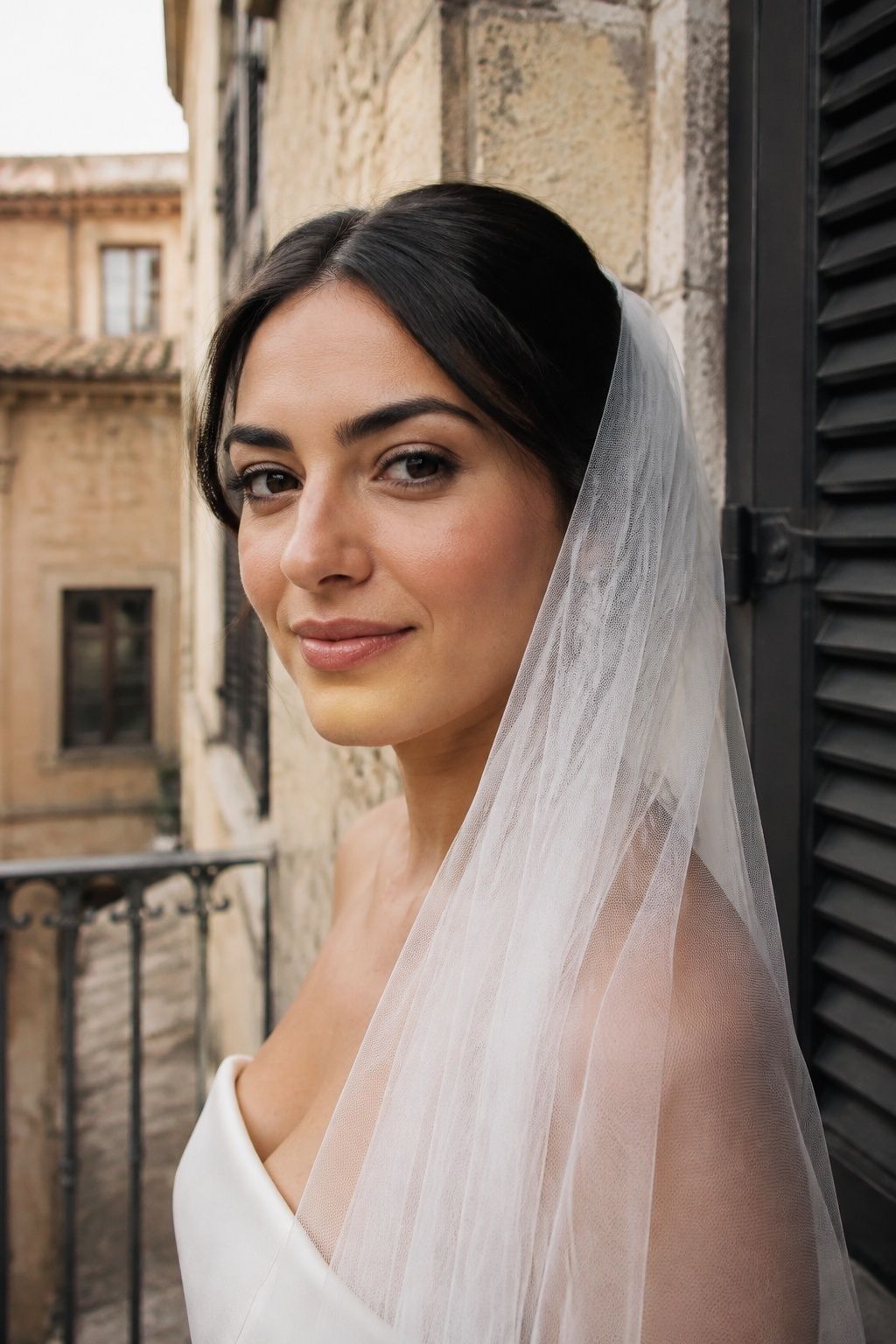
Save this one for the photo list rather than the ceremony. Keep your veil secure for the vows, then let the photographer pull the fabric across one shoulder for ten minutes of portraits, and you get that soft frame around your jaw that looks far more like a magazine than a center-back veil ever does. It’s lovely on a balcony or a staircase, and it holds up well in black and white.
Tell your photographer in advance that you’d like this, because moving a veil takes a minute and you don’t want to discover the idea on the day when the light is going. Your stylist can show one trusted person how to re-pin it afterward if you’re heading back out, and you can skip all the hair spray panic.
Fit And Attachment Checks
Run these two tests before you commit, ideally at the same appointment.
Test Attachment With Combs, Pins, Or Shoulder Points
The way the veil attaches decides whether it feels graceful or fussy. A comb grips better when there’s texture underneath, pins sit better when the stylist builds them in from the start, and shoulder points behave when a tailor has reinforced the dress. For a related look, see red veil wedding ideas.
Bring the veil, your earrings and every hair accessory to the trial. No veil yet? Bring a scarf of similar weight so the stylist can test the fall, then do a slow walk, a turn, a hug and a seated pose. You’ll find more like this in the Bridal Hair & Veils hub.
Check Wind, Stairs, And Hugging Comfort
Wind pushes fabric forward, stairs catch a chapel hem, and hugs are what actually pull a comb out, since everyone wraps their arms straight around the veil. Related reading: wildflower veil wedding ideas.
For a small wedding, choose the amount of veil your real room can hold. A narrow floor-length drape looks better than a wide train in a tight aisle, and a shoulder-length one gets through taxis and restaurant doors without a fight. Also worth a look: wedding hair and makeup mistakes.
Can You Wear a Drape Veil Over Your Face?
Yes, if the veil has a separate blusher layer or is long and sheer enough to bring forward for the entrance. A true drop veil is the easiest version, since it’s one sheet of fabric that goes over your face and folds back behind you once, with nothing to unpin.
Side-comb and cape-like drapes aren’t built for this, because the fabric starts at the sides or shoulders and has nowhere to come forward from. If a covered entrance matters to you, tell whoever is selling you the veil before you order, and have your person practice the lift, slowly, using both hands, so the hair underneath survives it.
Frequently Asked Questions
What is a drape veil for a wedding?
A drape veil is a veil chosen for the way the fabric falls softly from the head, side combs, shoulders or back neckline. There’s less volume at the comb than a standard veil, and more movement around your face and shoulders. For the next step, see mermaid drape wedding dress ideas.
How do you wear a drape veil?
Attach it above or below a bun, with two side combs, with pins on a braided base under loose waves, with a Juliet cap, or at the shoulders of the dress. Your hairstyle and the weight of the veil decide which one will hold. Related reading: cathedral veil with blusher wedding ideas.
Is a drape veil the same as a drop veil or cape veil?
Not quite. A drop veil falls in one smooth sheet from the head and often covers the face first, while a cape veil attaches at the shoulders. Drape is the broader word, and it covers drop, Juliet, side-comb and cape-like placements.
What hair goes best with a drape veil?
Low buns are the most secure. Half-up styles and loose waves work too when there’s a small braid or pinned section under the comb.
Is a drape veil suitable for a small wedding?
Yes, and it may be the best kind for one. Shoulder-length, side-comb and narrow chapel versions fit restaurants, courthouses and tight aisles, and they don’t need anyone assigned to carry them.
Key Takeaways
- Choose where the fabric starts before you choose the length.
- Soft tulle or English net falls properly, and stiff tulle springs out.
- Loose hair needs hidden structure under every comb.
- Decide who removes the veil, and in what order, before the wedding day.
Skip the Extra Yards, Keep the Good Pins
My strong opinion after writing all of that: a well-anchored shoulder or chapel drape beats a dramatic long veil that needs babysitting, every time. Spend your money on soft fabric and a proper hair trial, and let the veil do its thing during the ten minutes that matter.
Last update on 2026-11-29 / Affiliate links / Images from Amazon Product Advertising API