

Pair a marquise engagement ring with a band that leaves room for its two points: a V-shaped or curved band that hugs the stone, an open band that stops short of it, or a thin straight band with a small, deliberate gap. Check the setting height first, then add one slim layer at a time.
A marquise is the drama queen of diamond shapes (I say that with love). It makes fingers look slimmer and refuses to sit politely next to a plain wedding band the way a round stone does, which is why marquise engagement ring stack ideas need more planning than most.
The two tips stick out past the band, so a wedding ring can either hug them, frame them or leave them alone, and picking wrong means rubbing metal, a crooked stack or a gap you didn’t plan. Below are 14 stacks sorted by the question you’ll face at the jeweler, plus what to check before you buy anything.

Recommended Marquise Ring Stack Essentials
A sizing kit and a soft brush will save you more trouble than any band in this list.
No products found.
No products found.


No products found.
Recommended blogs to read:
- Ring Stack Wedding Ideas With Meaning In Every Layer
- Round Engagement Ring Stack Ideas That Feel Classic And Yours
- Radiant Engagement Ring Stack Ideas With Clean Modern Fire
- Oval Wedding Ring Set Stack Ideas With Soft Balance
- Elongated Hexagon Engagement Ring Ideas for Love With Sharp Little Edges
- Mixed Metal Ring Stack Wedding Bands Ideas With Warm Contrast
Marquise Engagement Ring Stack Ideas For Elongated Bridal Drama
Look at the points before you look at bands. Everything else in the stack depends on how far the tips reach and how high the stone sits.
| Band Style | Why It Works | What To Watch |
|---|---|---|
| V-shaped or chevron band | Frames one marquise point and makes the shape feel deliberate | The V should not press against the tip or prongs |
| Curved or contour band | Softens the space around the long stone and can look custom | The curve needs to match the setting height, not just the outline |
| Open band | Leaves room around the points while adding modern negative space | Ends should be smooth and placed where they will not snag |
| Straight band | Creates a clean, modern line with a purposeful gap | The gap should look intentional and the band should not rub the setting |
| Slim accent band | Adds texture, metal contrast, or a milestone layer without overpowering the marquise | Width and stone height matter more than shine |
1. Start With The Two Pointed Ends
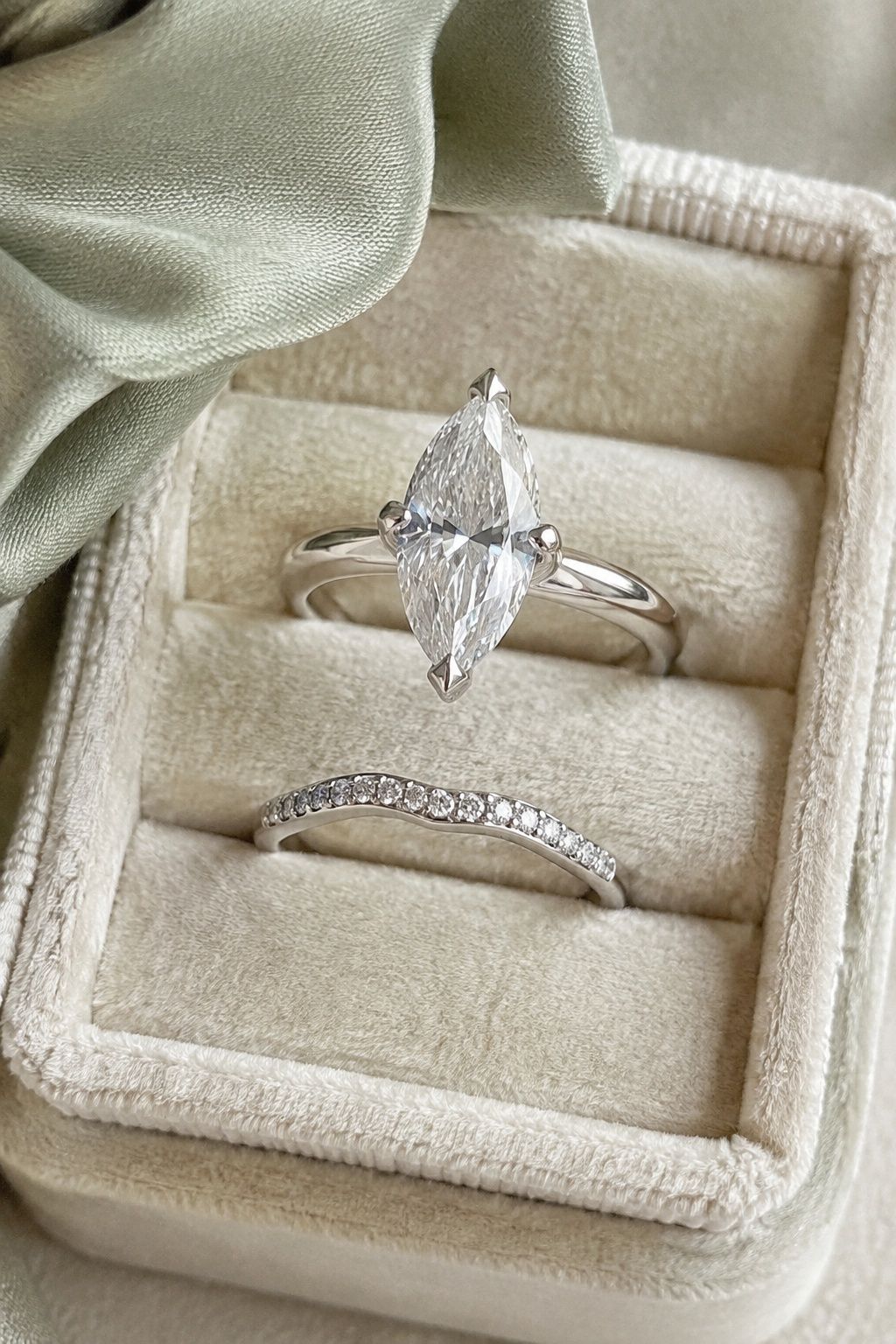
The two tips are the weakest spots on a marquise, and GIA’s marquise diamond guide says as much: cutters even leave the girdle a little thicker at the points to protect them. Most settings add a V-shaped prong over each tip for the same reason.
So before you fall for a band, find out how far those prongs reach. In a ring box like this ivory one, with the solitaire sitting above a thin pavé band, you can see the tips stick out past the shank on both sides, and that overhang is right where a second ring will want to sit.
Take the engagement ring with you when you shop for bands, always. Try every band on your finger next to it, look from above and from the side, and if metal touches a prong tip, that band is out, however pretty it looks on the tray.
2. Frame One Point With A V-Shaped Band
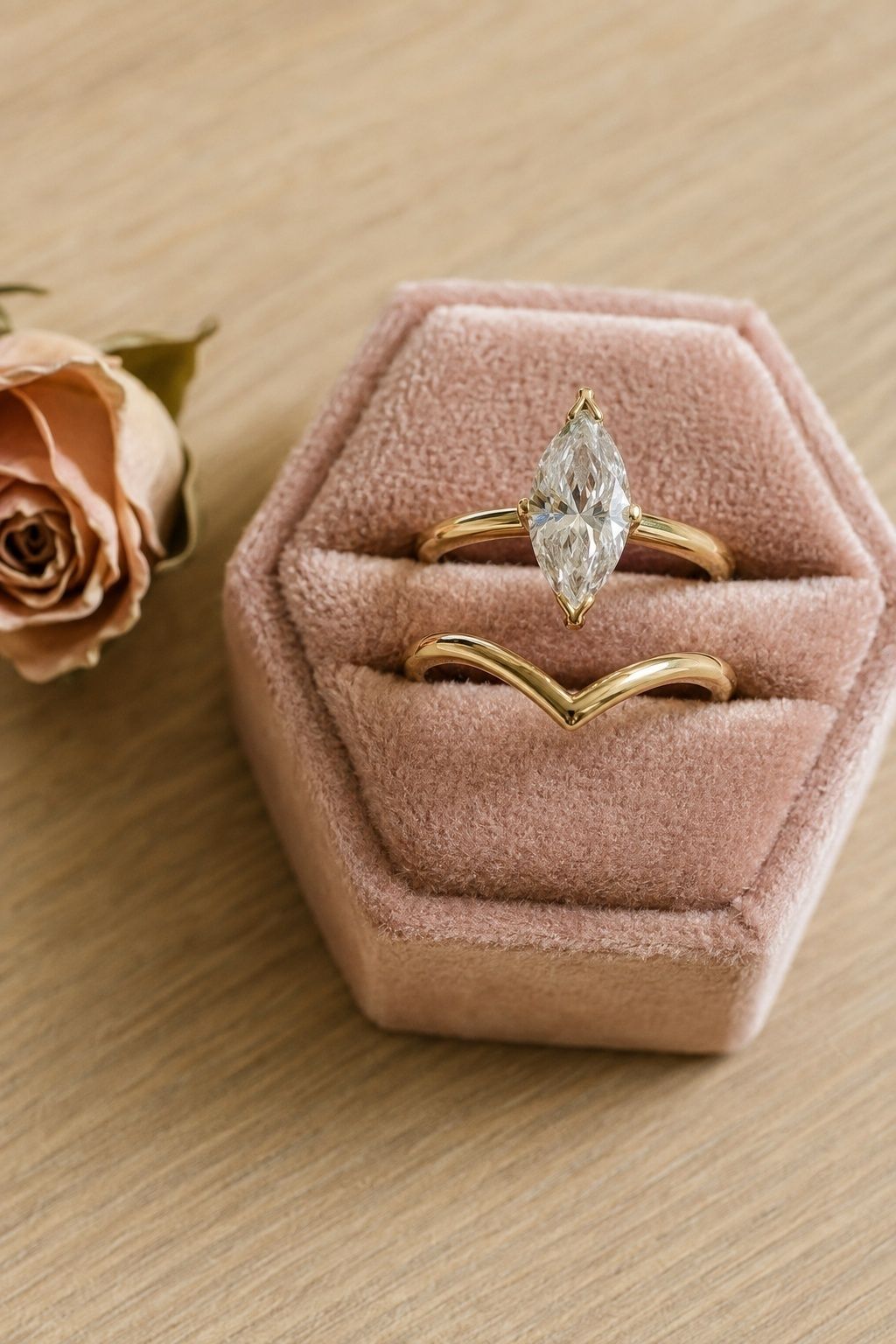
Want the stack that looks like it was designed as a set? A V-shaped band tucks under the lower tip and repeats the point, so the two rings read as one piece, especially in yellow gold like this pair in the blush velvet box. It’s the most popular answer for a marquise, and for good reason.
The angle of the V matters more than people expect. A sharp V that pushes into the tip of the stone will rub the prong over time, while a slightly softer angle leaves a hair of space and still looks matched. Ask the jeweler to slide the two rings together on your finger and check that they line up straight when your hand is flat.
3. Use A Curved Band For A Softer Stack
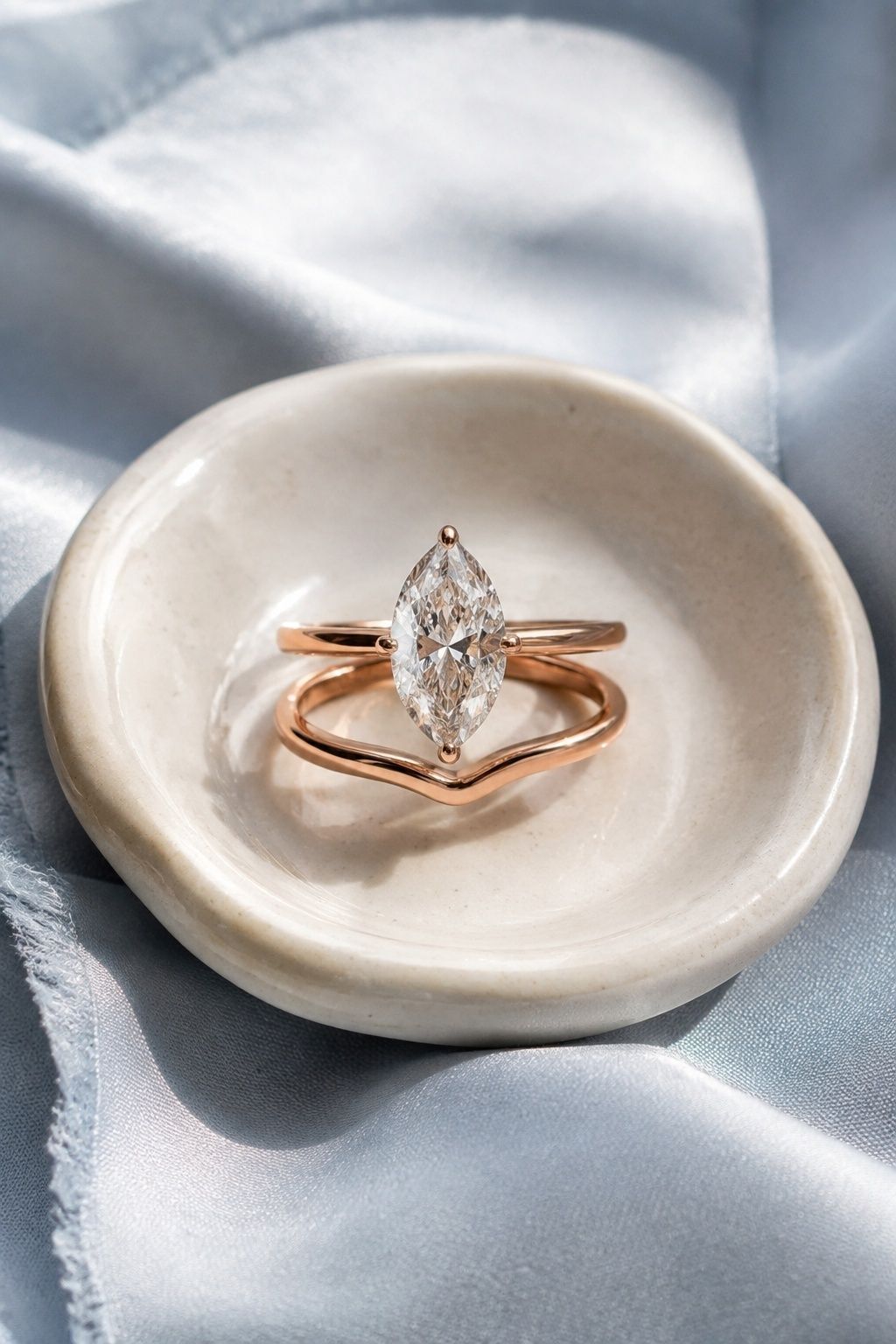
If a chevron feels too sharp for your style, a curved band gives you the same hug with a gentler line. In rose gold, the curve dips under the stone in one smooth swoop and the whole stack looks softer and a little vintage, which suits a marquise more than you’d think, since the shape was a big deal back in the 1970s. A curve also forgives a slightly tilted engagement ring better than a hard V does, because there’s no single point that has to line up perfectly with the tip. Bring the engagement ring to the fitting anyway, because a curve that matches the outline from above can still bump into the setting from the side.
4. Try A Contour Band When The Setting Sits Low

Low settings are great for daily life (fewer snags on sweaters) but terrible for straight bands, because there’s nowhere for the band to go. A contour band is shaped around the base of the setting, so it can sit tight against a low marquise like this platinum pair on green velvet. When you try one on:
- Look from the side and check the band follows the setting without lifting it.
- Run a fingertip along the join and feel for any spot where metal meets prong.
- Spin both rings on your finger and see if they stay locked together.
- Ask whether the band can be resized later without losing its shape.
Custom contour bands take a few weeks, so start this one early.
5. Let An Open Band Create Breathing Room
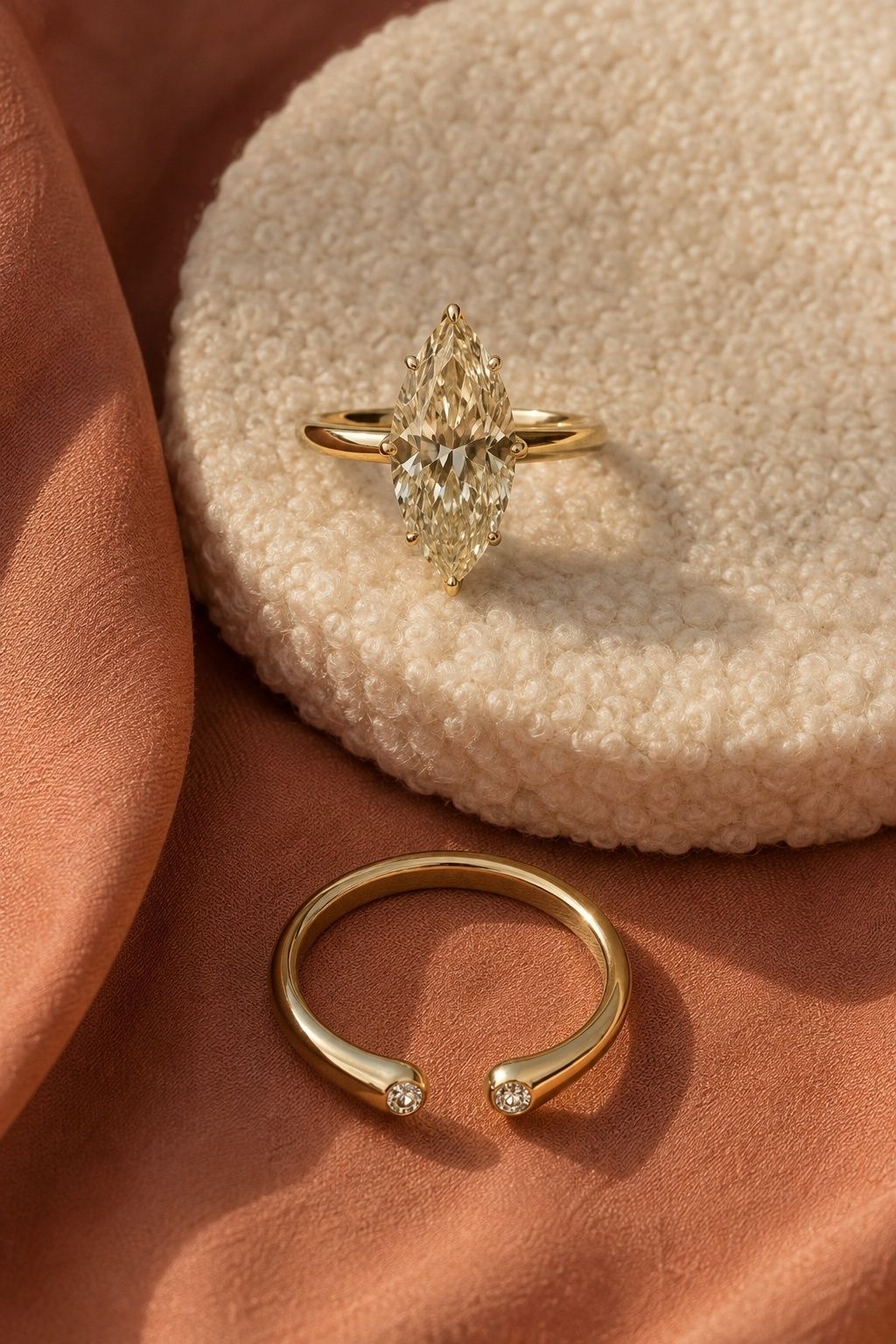
An open band stops before it reaches the stone, so the marquise points get all the space they want. The gold one beside this champagne-toned marquise has a small diamond at each end, which looks like the band is pointing at the center stone, and that’s a sweet detail for close-up photos.
The trade-off is the open ends. Smooth, rounded tips are fine, while square or sharp ends can catch on knits and lace sleeves. Run it over a sweater in the shop before you buy, and pick an adjustable size only if you’re happy to check it now and then, since open bands can slowly bend out of shape.
6. Make A Straight Band Look Intentional
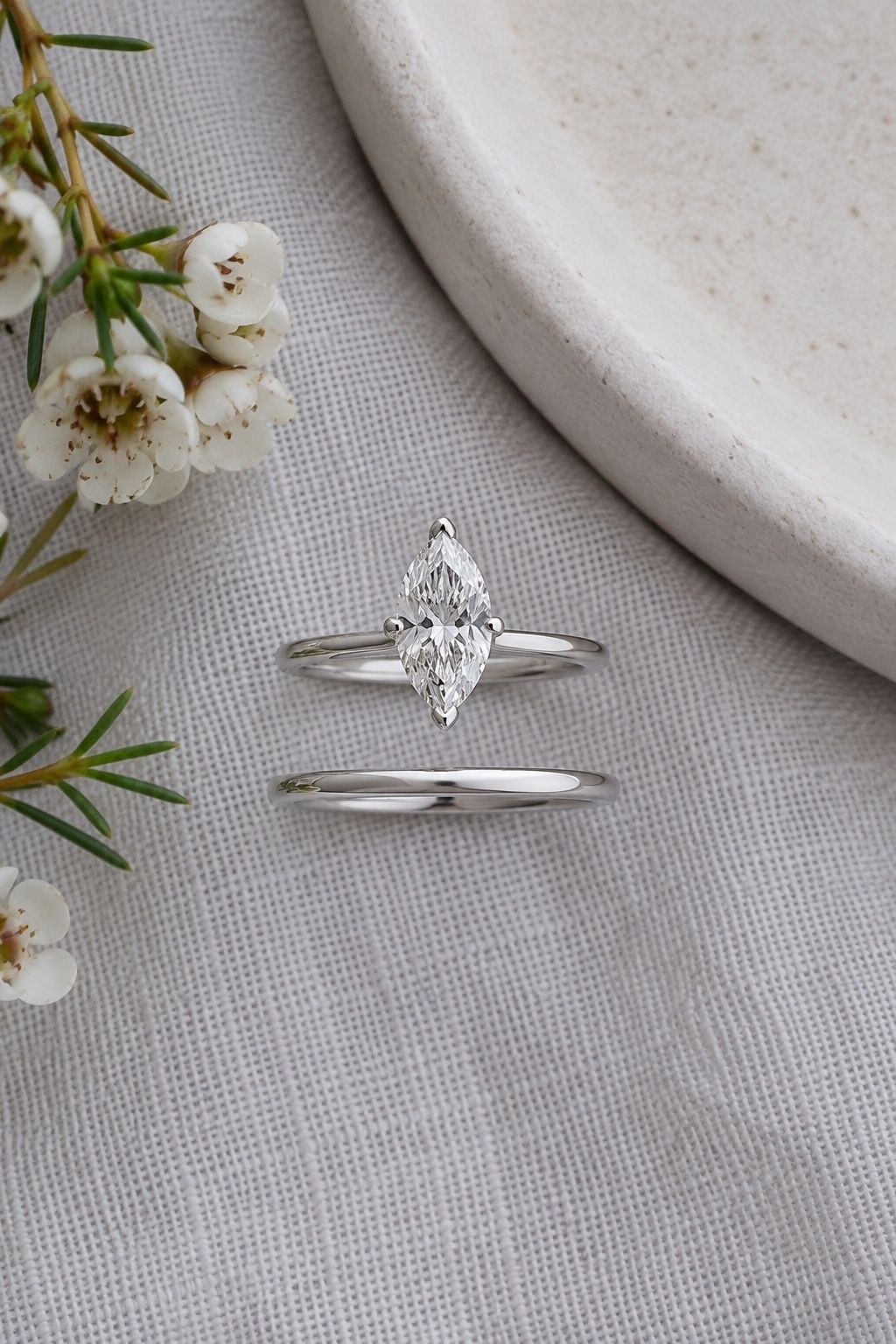
Can a plain straight band work with a marquise? Yes, if you make peace with the gap. Because the tips reach past the shank, a straight band usually sits a few millimeters away from the stone, and the job is to make that gap look chosen. A thin, plain white gold band next to a simple marquise solitaire, like this pair on gray linen, does it nicely, because both rings are equally slim and nothing tries to fill the space. This is also the cheapest stack on the list and the easiest to wear every day, and if you ever upgrade, a straight band goes with almost any future ring. Skip wide or chunky straight bands here, since a heavy band next to a gap just looks like a mistake.
How Many Bands Can a Marquise Stack Take?
Two or three is the sweet spot. Past that, the long stone starts competing with the bands instead of leading them.
7. Balance The Long Stone With Slim Side Layers
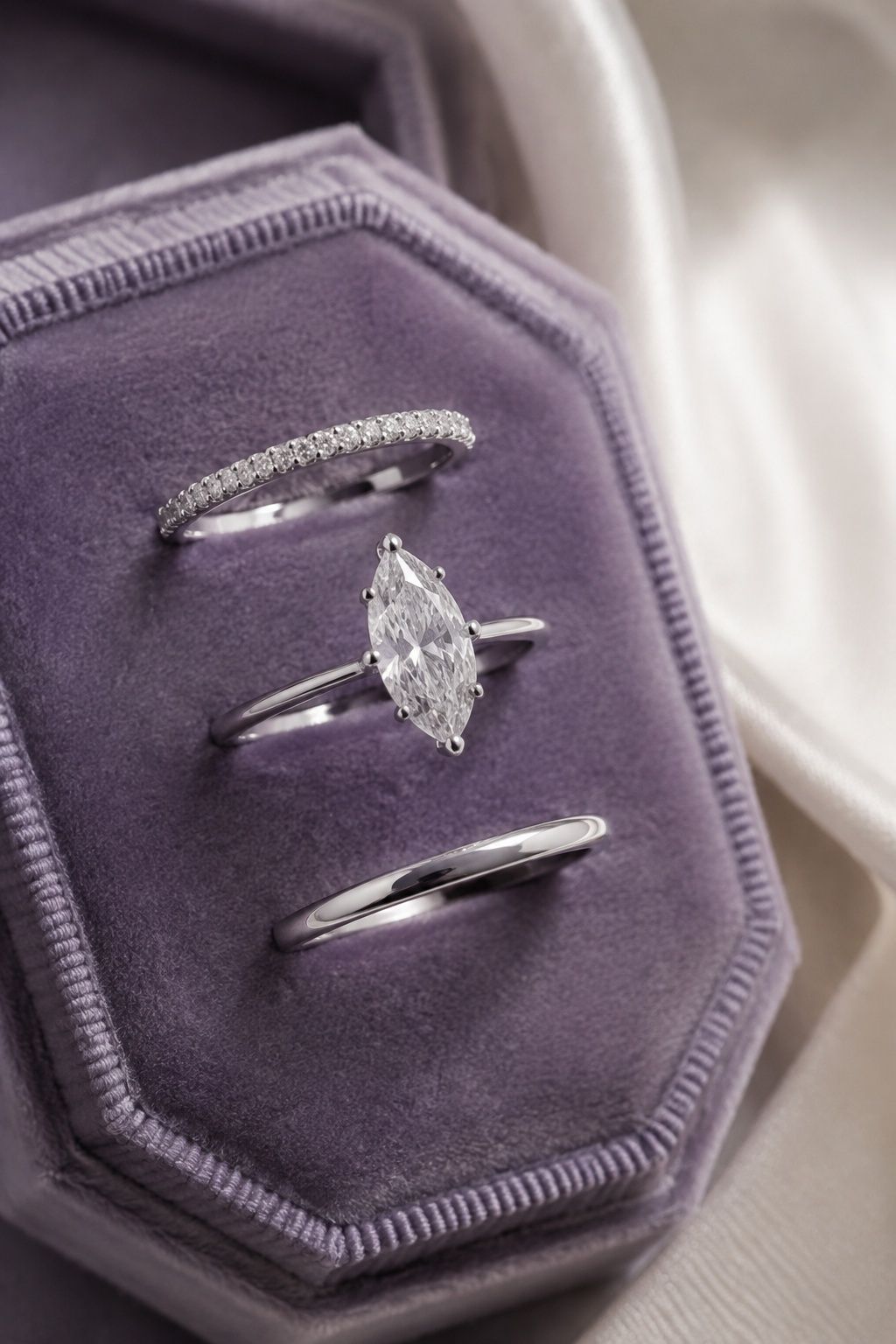
A long stone can carry a sandwich stack, one band above and one below, as long as both bands stay thin. In this lavender box, a narrow pavé band sits above the marquise and a plain band below, and nothing is wider than the engagement ring’s own shank.
That width rule is the whole thing. Measure the shank (most jewelers can tell you in millimeters) and keep every added band at that width or narrower, so the marquise stays the tallest and longest piece on your finger. If you love this balanced look on other shapes too, the oval wedding ring set stack ideas play with the same proportions.
8. Use A Spacer Ring When The Stack Rubs

Diamonds scratch everything, including other diamonds and the metal of your engagement ring, which is why pavé bands and solitaires rubbing all day slowly wear each other down. A spacer is a thin plain band that sits between them, like the slim one lined up between the marquise and the pavé band on teal suede here. It costs much less than either diamond ring and takes the friction instead of your prongs. Pick a spacer in the same metal as the engagement ring so it disappears into the stack, and choose a comfort-fit profile if your fingers swell in summer. Then show the whole stack to a jeweler once a year, since the spacer will be the first thing to show wear.
9. Choose One Drama Moment
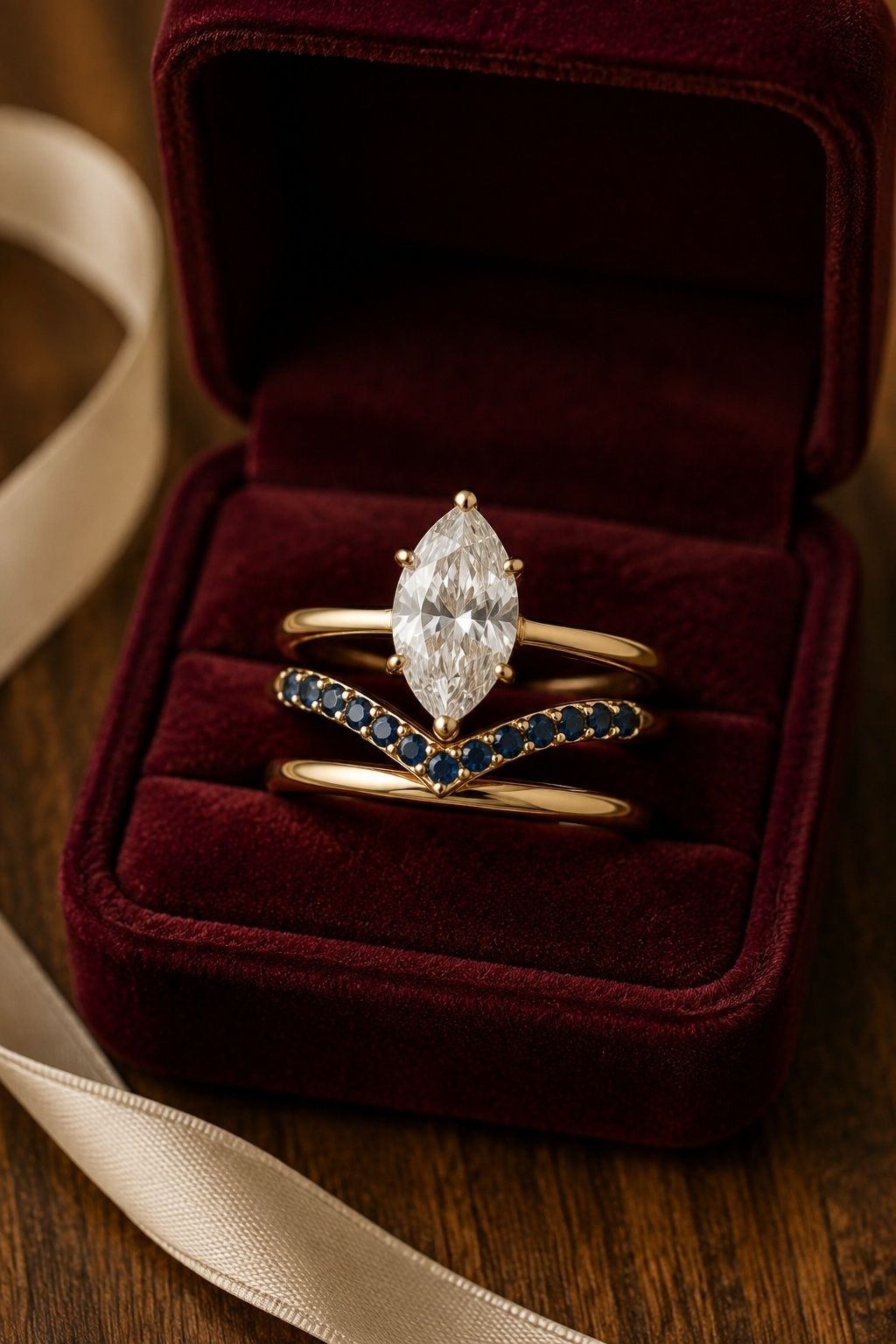
Pick one statement band and let everything else go quiet. A marquise already has drama built in, so a stack that adds a second big idea, plus a third, ends up looking busy instead of special.
The burgundy box here gets it right: a V-shaped band set with dark blue sapphires is the drama, and a plain gold band below just finishes the stack. The sapphires could easily be emeralds or your birthstone instead, as long as it stays the one loud thing. If you’d like more ideas for building around a single standout layer, the ring stack wedding ideas post has plenty.
10. Keep Pave Low And Fine

Pavé looks lovely next to a marquise, and it also brings the most wear problems, because those tiny stones sit in tiny prongs that can catch on the engagement ring all day. A low, thin pavé band like the one on this stone dish keeps the sparkle without stealing attention. Before you buy one, ask the jeweler:
- Is it a half eternity or full eternity band? Half is easier to resize.
- How high do the stones sit, and will they touch the marquise basket?
- Are the stones set in shared prongs, and how often should I have them checked?
- Will it match the white of the engagement ring’s metal after a few years?
Then wear the two rings together in the shop for a few minutes and listen for clicking, which means they’re rubbing.
How Do You Mix Metals and Shapes in a Marquise Stack?
Repeat one thing across the stack, like the band width or the stone shape, and you can change almost everything else.
11. Try Mixed Metals With A Repeated Shape
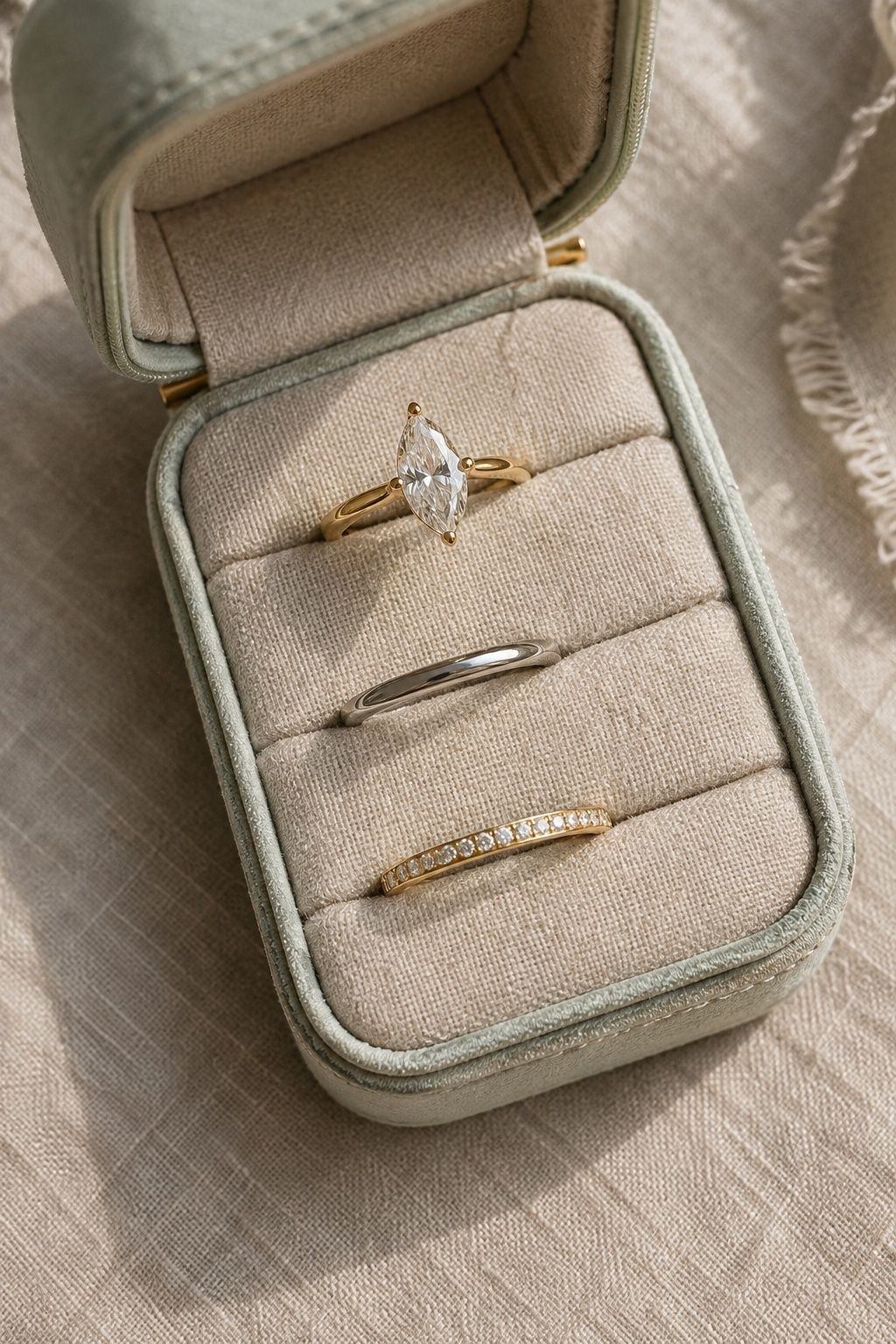
Mixed metals look collected rather than random when something repeats. In this sage box, the marquise and the pavé band are both yellow gold and the band between them is platinum, so the white metal reads like a deliberate stripe rather than a ring that wandered in from another set. Keep the band widths the same and the stack holds together even with two colors. This is also a nice way to include an heirloom band in a different metal, since you don’t need to match anything except the width. The mixed metal ring stack wedding bands ideas go further if you want three metals in one stack (bold, but it can work).
12. Pair Angular Bands With Other Sharp Shapes Carefully

Points plus more points can get tense fast. A marquise already has two hard tips, so adding a knife-edge band, a chevron and a baguette, like the three laid out on charcoal felt here, turns the stack into a geometry lesson unless one of them stays plain.
Pick one angular partner and keep it slim. A faceted knife-edge band works well because it catches light like the stone without adding another point, while a V band with a baguette is better as the only extra ring. The radiant engagement ring stack ideas show how other cornered shapes handle sharp bands.
How Do You Make a Marquise Stack Easy to Live With?
Round off anything that catches and plan where the rings go when your hands are busy.
13. Soften The Stack For Daily Wear
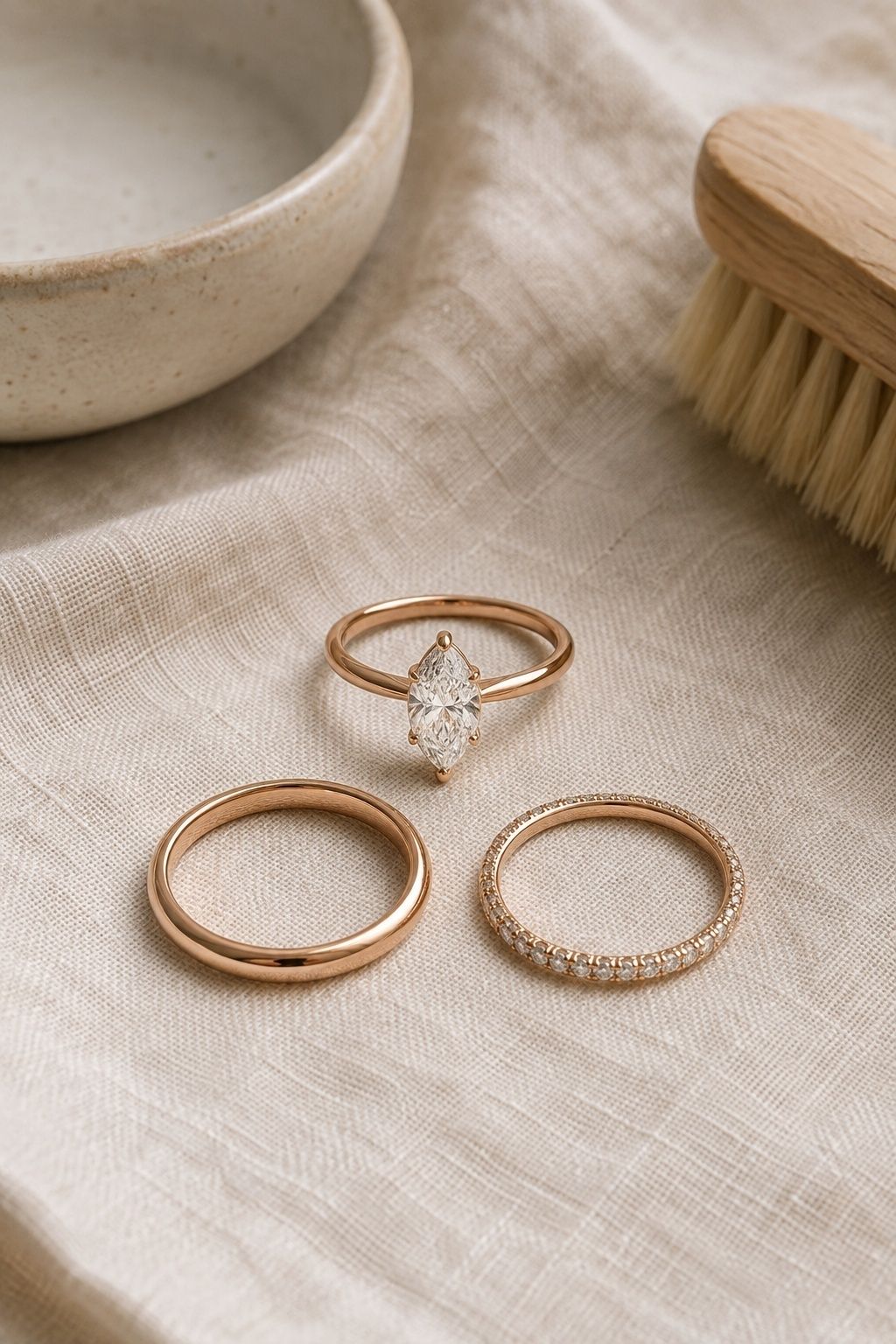
I spent about 15 years in kitchens, so my first thought about any ring is “what happens when I’m busy with my hands?” With a marquise, the answer is usually snagging on knits and bumping the tips on counters and doors.
The rose gold stack on this linen does well on that test. The middle band is plain with a rounded, comfort-fit edge, the pavé band is thin, and there are no sharp ends anywhere, so the rings slide past fabric instead of grabbing it.
A soft brush and warm soapy water keep the stones bright, and a little dish by the sink gives the rings somewhere to land while you cook or put on lotion. Boring advice, I know, but a stack you can forget about is the one you’ll wear for decades.
14. Plan The Close-Up Photos
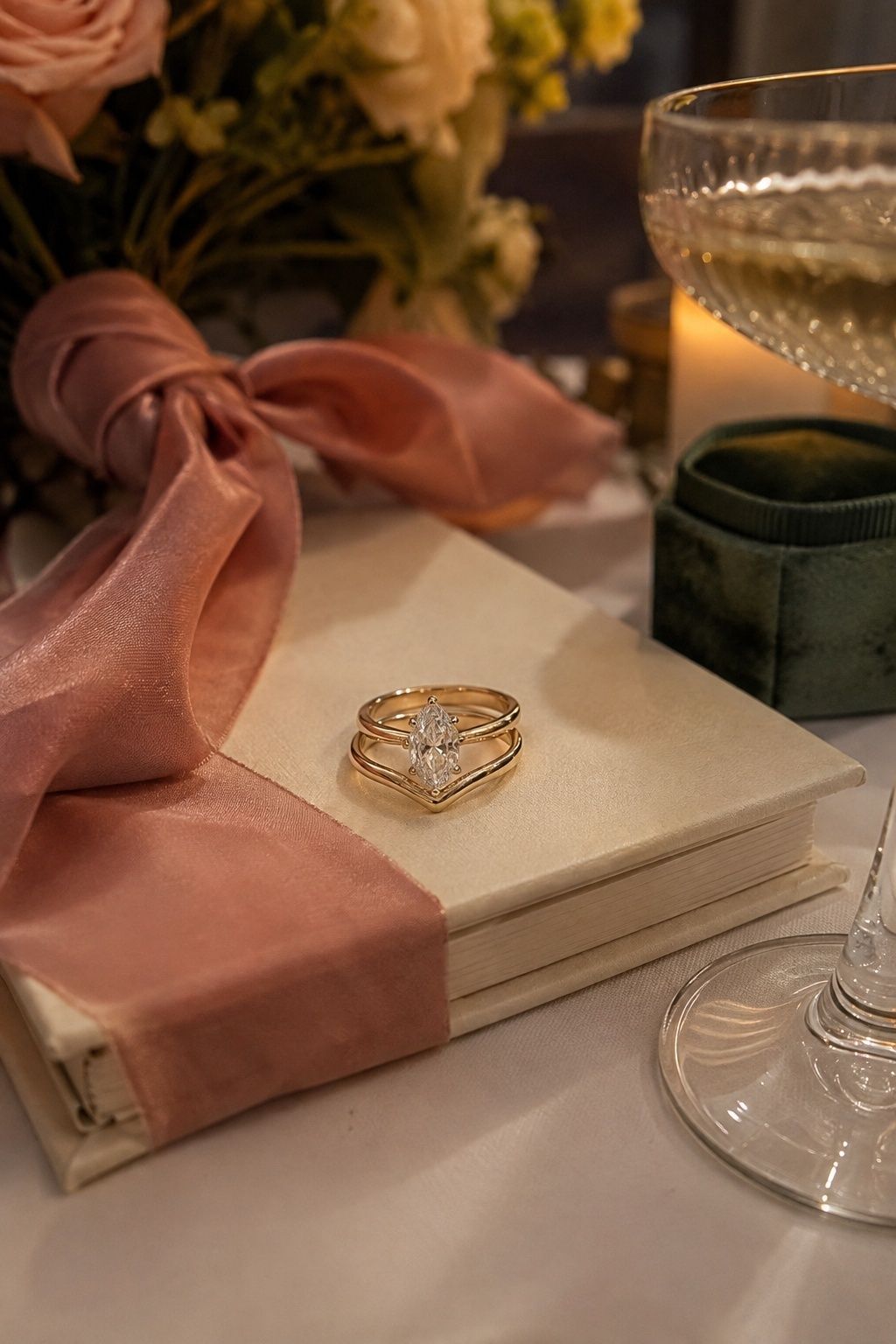
The ring shot is one of the few wedding photos where the stack is the whole story, so give your photographer something nice to put it on. A gold marquise with its V band resting on a cream book, with a dusty pink ribbon and a champagne coupe in soft focus behind, says “wedding” without anyone’s hand in the frame. Easy props for a small wedding:
- your vow book or the invitation
- a ribbon from the bouquet
- the ring box itself, open
- a glass from the toast, out of focus behind
Clean the rings the morning of the wedding, because every smudge shows up at that distance.
Is a Marquise a Good Shape for an Engagement Ring?
Yes. A marquise has the largest surface area of any diamond shape for its carat weight, so it looks bigger than a round of the same size, and it makes fingers look longer.
The downsides are the fragile tips and a possible dark “bow-tie” shadow across the middle of the stone, so look at it in person and choose prongs that cover both points.
What Are the Rules for Stacking Rings?
The traditional order puts the wedding band closest to your heart, below the engagement ring, but there’s no rule you have to follow. Most people stick to two or three rings on one finger, keep bands no wider than the engagement ring’s shank and add a spacer when diamonds touch. There’s more in our Wedding Rings & Jewelry collection.
Frequently Asked Questions
What bands go with a marquise engagement ring?
V-shaped, curved, contour and open bands all fit around the points of a marquise. A thin straight band also works if you’re fine with a small gap between the rings.
Do marquise engagement rings need V-shaped bands?
No, a V band is just the most popular match, and a curved, contour or open band does the same job.
Can a straight wedding band work with a marquise ring?
Yes, as long as it’s slim and the setting doesn’t sit too low. There will usually be a small gap between the rings, which looks intentional when both rings are thin.
How do you protect the points on a marquise ring stack?
Choose a setting with V-prongs over both tips, keep bands from touching those prongs and add a plain spacer if anything rubs. Then have a jeweler check the prongs once a year.
Should the wedding band go above or below a marquise engagement ring?
Traditionally the wedding band goes below, closest to the heart. With a marquise, though, wear it wherever the two rings sit flattest together. Many people switch the order once they see both options on their own hand.
Key Takeaways
- Check how far the marquise tips reach before choosing any band.
- V, curved, contour and open bands hug the points; slim straight bands leave a planned gap.
- Keep every added band as thin as the engagement ring’s shank.
- Add a spacer when diamonds touch, and have the prongs checked yearly.
So, Which Marquise Stack Is Yours?
A marquise gives you more stacking choices than almost any other shape, and the right one depends on how high your stone sits and how you use your hands. Are you a matching V-band person, a gap-and-straight-band minimalist or somebody who wants one bold sapphire chevron and nothing else? Keeping it small? See civil ceremony ideas.
Last update on 2026-11-29 / Affiliate links / Images from Amazon Product Advertising API