

How to tell family you are eloping: tell the closest people personally, lead with love, state that the ceremony is private and already decided, then offer one clear way for them to share in the joy afterward. Keep the explanation short, avoid asking permission, and repeat the same boundary kindly if family pressure starts.
Telling family you are eloping often feels harder than choosing the ceremony itself. You are sharing happy news, but you are also stepping outside the wedding story some relatives already imagined for you.
The goal is not to make every person instantly comfortable. The goal is to be respectful, clear, and steady so your private wedding does not become a group negotiation before you even reach the vows.
Recommended Wedding Products


You Might Also Like These Blog Posts
- How To Announce You Eloped Without Making It Feel Like An Apology
- How Soon After Eloping Should You Have A Party?
- Party After Eloping Etiquette For Sharing The Joy Without Rewriting The Day
- Should You Have A Registry After Eloping?
- Do You Invite People To Celebrate After Eloping If The Ceremony Was Private
- How To Set Wedding Boundaries With Family Before Your Guest List Learns To Multiply
How To Tell Family You Are Eloping Without Turning It Into A Fight
The best conversation starts before the announcement line. Sit together as a couple and decide what is already settled: the date, location, guest list, privacy level, and whether anyone will be invited. If those answers feel fuzzy, relatives will hear room to negotiate.
If you are searching for how to tell parents you are eloping, begin with the same answer you will give everyone else: the ceremony is private, the decision is made, and your love for them is still real. That keeps the elopement conversation with parents from turning into a vote.
Your family does not need every private reason behind the choice. They need enough honesty to understand that the decision is loving, deliberate, and final. A short explanation usually works better than a long defense because long defenses create openings for counterarguments.
Use language that keeps the emotional center on the marriage. Try: “We have decided to exchange vows privately. We know this is different from what some people imagined, but it feels right for us, and we wanted to tell you with love before we share it more widely.”
That wording does three useful things. It tells them the decision is made, it recognizes expectations, and it keeps the relationship warm. It also avoids blaming money, relatives, family tension, or stress in a way that invites someone to fix the problem by changing your plan.
Decide Who Hears The News First

For most couples, parents, siblings, children, and anyone who expected a direct role should hear before extended family and social media. This order is not about asking permission. It is about preserving trust where trust matters most.
If one side of the family is more reactive, do not reward that behavior with earlier control over the plan. Tell people in an order that feels fair, but protect your calm. A difficult parent does not get extra access simply because they are difficult.
When families are blended, divorced, estranged, or complicated, map the calls before you start. Decide whether separate conversations will be kinder than a group reveal. If one parent tends to speak over the other, a private call gives the quieter person space to respond honestly.
Tell Parents With Love And A Clear Boundary

The parent conversation often carries the most emotion because parents sometimes hear an elopement as exclusion. Soften that without giving away the decision. Start with care: “We love you and wanted you to hear this from us first.”
Then say the choice plainly: “We are getting married in a private ceremony with just the two of us.” If a witness or photographer will be present, say that too. Clear details reduce the chance that someone imagines a secret guest list they were left off.
After that, offer the boundary: “We are not opening the ceremony to guests, but we would love to celebrate with you afterward.” This keeps the door open relationally while closing the door logistically.
If parents ask why, give one calm reason. “We want the ceremony to feel quiet and focused.” “We are trying to avoid a larger event.” “This is the way we feel most like ourselves.” You do not need a courtroom-level argument for a private wedding.
How To Tell In Laws You Are Eloping Without Mixed Messages
In-law conversations go better when each partner does not leave the other to absorb the hard feelings alone. Present the decision as shared, even if one person has the more complicated family. The message should sound like “we decided,” not “your son wants” or “your daughter prefers.”
If one family expects tradition and the other does not, keep the wording consistent. Personalize the warmth, but keep the boundary matched on both sides. Uneven explanations lead to comparisons, and comparisons turn a private ceremony into a fairness argument.
When a future in-law pushes for exceptions, answer as a couple: “We understand why you wish it were different. We are keeping the ceremony private for everyone, and we are excited to celebrate with you afterward.” Repeat it calmly. Repetition is often the kindest boundary.
Choose The Right Method For Each Relationship
A face-to-face conversation is best for close family when distance and safety allow it. A video call or phone call works well when relatives live far away. Text works for logistics afterward, but it rarely carries enough warmth for the first reveal to parents or siblings.
For extended relatives, an announcement card, email, wedding website update, or group message works after immediate family has heard directly. The closer the relationship, the more personal the first message should feel.
If someone is unsafe, manipulative, or likely to sabotage the ceremony, protect the wedding first. Direct does not have to mean early. In strained family systems, telling people after the vows often keeps the day peaceful.
Use Scripts That Sound Like You
For parents before the elopement: “We wanted to tell you ourselves before anyone else hears. We have decided to elope and exchange vows privately. We know this is not the wedding some people imagined, but it feels peaceful and honest for us. We love you, and we hope to celebrate together afterward.”
For parents after the elopement: “We have happy news. We got married in a private ceremony, and it was exactly what we needed. We know you probably have feelings about missing the ceremony, and we want to talk with you about that. We love you and wanted you to hear it from us directly.”
For in-laws: “We are keeping the ceremony private on both sides of the family. This is not about choosing one family over another. It is the scale that feels right for us, and we are looking forward to sharing photos and celebrating with you soon.”
For extended family: “We are so happy to share that we are getting married in a private ceremony. We are keeping the vows small, and we are grateful for your love as we celebrate this new chapter with you.”
Prepare For The First Reaction Without Obeying It
A family reaction to elopement news often arrives as joy, quiet, confusion, tears, or anger. The first reaction is not always the final relationship. Give people a little room to feel surprised without treating surprise as a reason to change your wedding.
If someone says, “How could you do this to us?” answer the feeling without accepting the accusation. “I hear that this hurts. We did not choose this to hurt you. We chose it because this is the ceremony that feels right for us.”
If someone starts bargaining, stay specific. “We are not adding guests to the ceremony.” “We are not changing the date.” “We are happy to plan dinner after.” Clear sentences feel awkward for a moment, but they prevent weeks of circular debate.
Do not overpromise to soothe the room. If you do not want a large party later, avoid saying, “We will have a big celebration soon.” Offer only what you are genuinely willing to do: a meal, a photo call, printed announcements, or a small gathering.
Explain Eloping Without Apologizing For It
How to explain elopement to family starts with restraint. Give the emotional truth, not every private detail: you want the vows to feel quiet, simple, and protected.
Many couples start apologizing because they want to be kind. Kindness is good; apologizing for the marriage plan makes the choice sound wrong. Replace “We are sorry” with “We know this is different.” That small shift gives empathy without surrendering the decision.
Try, “We know you pictured being there, and we understand why that matters.” Then move back to the truth: “We are choosing a private ceremony because we want the vows to feel quiet, simple, and centered on us.”
If money, anxiety, faith differences, divorce dynamics, guest-list conflict, or family pressure shaped the choice, share only the parts that will not create a new argument. The goal is understanding, not a public audit of everything that made a larger wedding feel impossible.
Announce The Elopement To Family Afterward
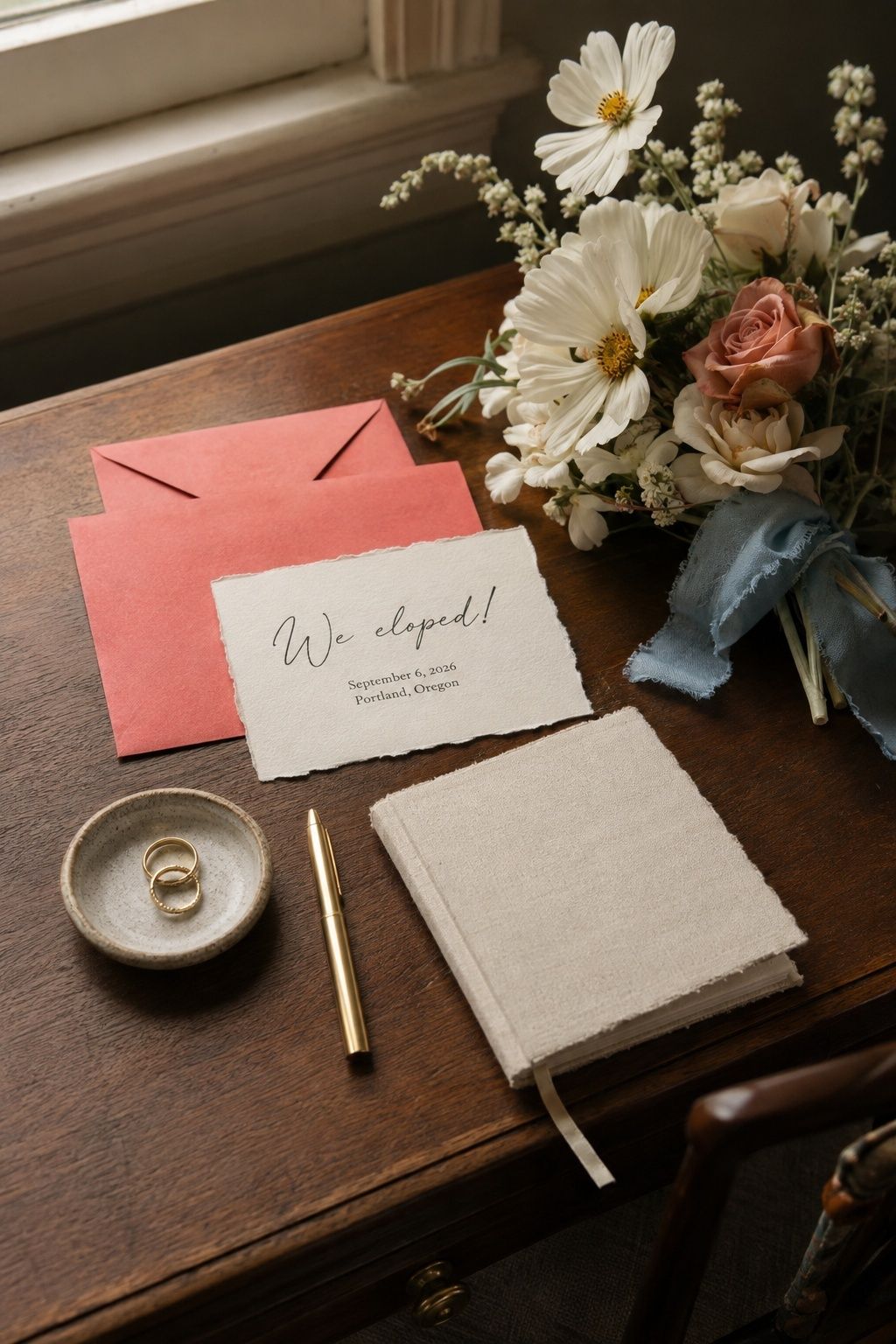
If you are telling family after the ceremony, move quickly with the closest people. Let parents and siblings hear before a public post goes up. The order matters because people often forgive surprise more easily than feeling last.
To announce elopement to family with care, choose one clear path for each circle: calls for the closest people, a card or email for extended relatives, and a public post only after the private messages are finished.
A simple after-elopement call sounds like this: “We got married yesterday in a private ceremony. It was beautiful and very us. We wanted to tell you personally before we share more widely. We love you, and we hope you feel happy with us even though the ceremony was private.”
After those calls, send announcement cards or a thoughtful message to the wider family. Include the date, location, and a photo if you have one. If you plan to host a party, separate the news from the invite enough that the celebration feels warm instead of corrective.
Set Boundaries After The News Is Out
The conversation does not end the first time you say it. Family members who dislike the plan sometimes return with new angles: one witness, one parent, a small dinner before, a quick blessing, a livestream, a dress-shopping trip, or a promise that nobody else has to know.
When elopement family drama starts circling the same complaint, set boundaries around both access and repetition. Answer once with tenderness, then decline to keep reopening the ceremony plan.
Decide ahead of time which requests are welcome and which are not. Welcome a family toast after the trip, a photo album night, or a private blessing if those feel good. Decline ceremony witnesses, planning committees, guest-list suggestions, and repeated conversations about why the elopement is happening.
Use the same closing line each time: “We love you, and the ceremony plan is set.” The sentence is short because the decision is short. Stay affectionate before and after it, but keep the boundary itself easy to understand.
Give Loved Ones Somewhere Loving To Put Their Energy

Some family drama softens when people know where to put their love. If you want involvement without ceremony pressure, give specific invitations: choose a dinner spot together, pick a song for the celebration playlist, gather family addresses, host a toast after the trip, or look through photos together.
Be careful with symbolic jobs that look like a back door into planning. If you ask a parent to weigh in on attire, flowers, or vows, they could reasonably think the wedding is partly open for discussion. Choose involvement that supports the relationship, not the ceremony logistics.
For eloping without family, a post-ceremony ritual often matters. A handwritten letter to parents, a framed photo, a Sunday brunch, or a short video call from the honeymoon gives people a real moment without rewriting the private wedding.
Know When Not To Keep Explaining
If every explanation becomes a debate, stop explaining. You are allowed to repeat the same kind line and leave the conversation. “I love you. I know you are disappointed. We are not debating the ceremony anymore.”
This is especially important when family expectations have a long history of expanding. A small private wedding grows into a 60-person event one exception at a time. Protecting the plan early is easier than trying to shrink it later.
After the conversation, take care of yourselves. Go for a walk, eat something, put phones away, or return to one wedding detail that feels joyful. The point of eloping is not to win an argument. It is to get married in a way that lets you be present.
FAQ
How Do You Tell Family You Are Eloping?
Tell family you are eloping with a private conversation before the news spreads elsewhere. Lead with love, say the ceremony is intentionally private, and give one simple reason without inviting a debate. Close by naming how they still matter, whether that means a call, dinner, photos, or a celebration later.
How Do You Tell Parents You Are Eloping?
Tell parents before extended relatives if the relationship is steady enough for that order. A call or in-person conversation usually lands better than a text. Say, “We love you, and we wanted you to hear this from us first. We are choosing a private ceremony, and we hope you still feel included in our joy.”
Should You Tell Family Before Or After You Elope?
Tell family before you elope if secrecy would cause lasting damage or if you want them emotionally prepared. Tell them after if privacy protects your peace, safety, or the ceremony itself. The kinder choice is the one that gives you a calm wedding and gives loved ones direct, respectful communication.
What If Family Reacts Badly To An Elopement?
If family reacts badly, stay calm and repeat the decision without defending it point by point. Acknowledge disappointment while keeping the boundary intact: “I know this is hard to hear. We made this choice with care, and we are not changing the ceremony plan.”
How Do You Tell In-Laws You Are Eloping?
Tell in-laws as a united couple, ideally with each partner leading the conversation with their own side. Keep the wording consistent so one family does not hear a softer or more negotiable version than the other. Warmth matters, but mixed messages invite pressure.
How Do You Avoid Hurt Feelings After Eloping?
Avoid some hurt feelings by telling close people personally, sharing the news before social media, and offering a thoughtful way to celebrate afterward. Other people’s reactions are theirs, but direct care keeps loved ones from hearing about the marriage casually or last.
Final Thoughts
Eloping does not mean your family matters less. It means the ceremony needs a smaller, quieter shape than they expected. When you lead with affection and keep the boundary plain, loved ones get a better chance to meet the marriage with tenderness instead of panic.
Let the first conversation be warm, brief, and steady. Give the people who love you time, while your wedding stays private, joyful, and fully yours.
Last update on 2026-10-03 / Affiliate links / Images from Amazon Product Advertising API